


There are places where communication is easy.
Syria is not one of them.
For organizations, NGOs, institutions, community initiatives, and professional groups working in Syria, communication is rarely about “publishing content.” It is about building trust in a difficult environment. It is about explaining work clearly. It is about reaching people with respect. It is about helping communities understand, learn, participate, and feel seen.
That is why podcasting in Syria matters more in 2026 than it did a few years ago.
A podcast is not just a media format. Used properly, it can become a space for explanation, learning, storytelling, and human connection. It allows organizations to speak with people, not only at them. It gives leaders, experts, field teams, educators, community workers, and beneficiaries a way to share knowledge in a more personal and thoughtful form.
In a country where trust, clarity, and community understanding are essential, podcasting can do something many formats struggle to do.
It can slow the conversation down.
Why Podcasting in Syria Matters Now
Syria’s digital environment is still challenging, but digital communication is part of everyday life for millions of people. DataReportal’s 2026 Syria report estimates that there were 9.25 million internet users in Syria at the end of 2025, with internet penetration at 35.8%. That means digital access is not universal, but it is large enough for organizations to take online communication seriously.
This is important because podcasts do not require the same kind of attention as long written reports or formal videos.
People can listen while moving, working, commuting, waiting, or doing daily tasks. A podcast episode can be shared on social platforms, embedded into websites, sent through messaging groups, used in training, or repurposed into short clips and written summaries.
For organizations and NGOs, this creates an opportunity.
Not everyone will read a long PDF.
Not everyone will attend a live session.
Not everyone will engage with a formal awareness campaign.
But many people may listen to a conversation if it feels relevant, human, and useful.
The Communication Challenge for Organizations and NGOs
Organizations in Syria often carry important messages, but those messages do not always reach people in the way they should.
An NGO may want to explain a health program.
A local initiative may want to raise awareness about education.
A professional association may want to share practical knowledge.
A community organization may want to address misinformation.
A leadership team may want to speak more clearly with staff and volunteers.
The challenge is not only distribution. It is trust.
People may ask:
Who is behind this message?
Why should I believe it?
Does this organization understand our reality?
Is this information useful, or is it just another announcement?
Are they speaking our language, or speaking like a report?
This is where organizational podcasting in Syria can become valuable.
A podcast gives the organization a voice. Not only a logo. Not only a statement. A voice.
And voice matters when people need reassurance, explanation, and consistency.
Why Podcasts Work in a Syrian Context
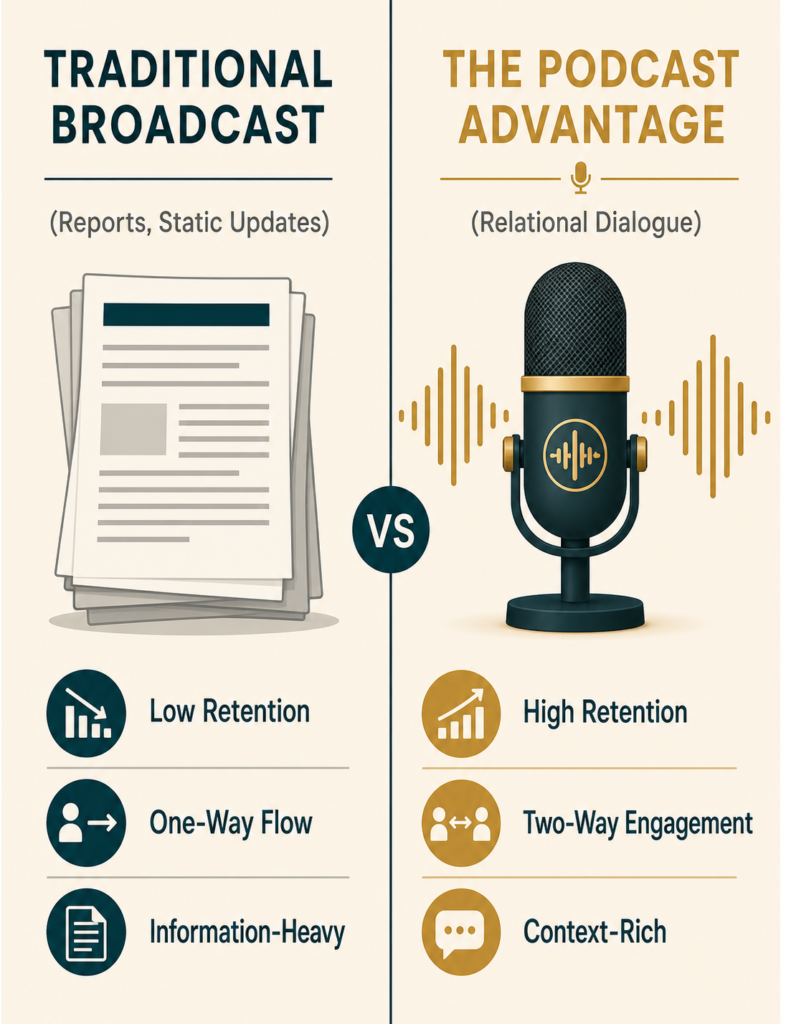
Podcasting is powerful because it feels close.
A written announcement can sound official.
A social media post can feel too short.
A video can require full attention.
A podcast can sit somewhere in between: thoughtful, accessible, and personal.
For Syria, this matters for several reasons.
First, many topics need context. Social work, health, education, livelihoods, youth development, community rebuilding, entrepreneurship, legal awareness, and psychosocial support cannot always be explained well in a short post.
Second, people often trust people more than institutions. When they hear a real conversation with a field worker, doctor, trainer, teacher, community leader, or program manager, the message feels less distant.
Third, podcasts allow for nuance. They can explain what is happening, why it matters, what people can do, and where they should be careful.
In sensitive environments, nuance is not a luxury. It is necessary.
Podcasting as a Trust-Building Tool
Trust is not built by saying “trust us.”
It is built through repeated clarity.
A podcast can help organizations build trust by showing how they think, how they work, and how they listen. It gives space for questions that people may already have but do not always ask publicly.
For example:
Why is this program important?
Who can benefit from it?
What should people expect?
What are the limits of what the organization can offer?
How are decisions made?
What lessons have been learned from the field?
What does the community need to understand before participating?
These are not always marketing questions. They are trust questions.
A good podcast does not have to sound polished to the point of distance. It should sound prepared, respectful, and real.
This is especially important for podcasts for NGOs in Syria, where communication must avoid exaggeration, respect local realities, and protect dignity.
How NGOs in Syria Can Use Podcasts
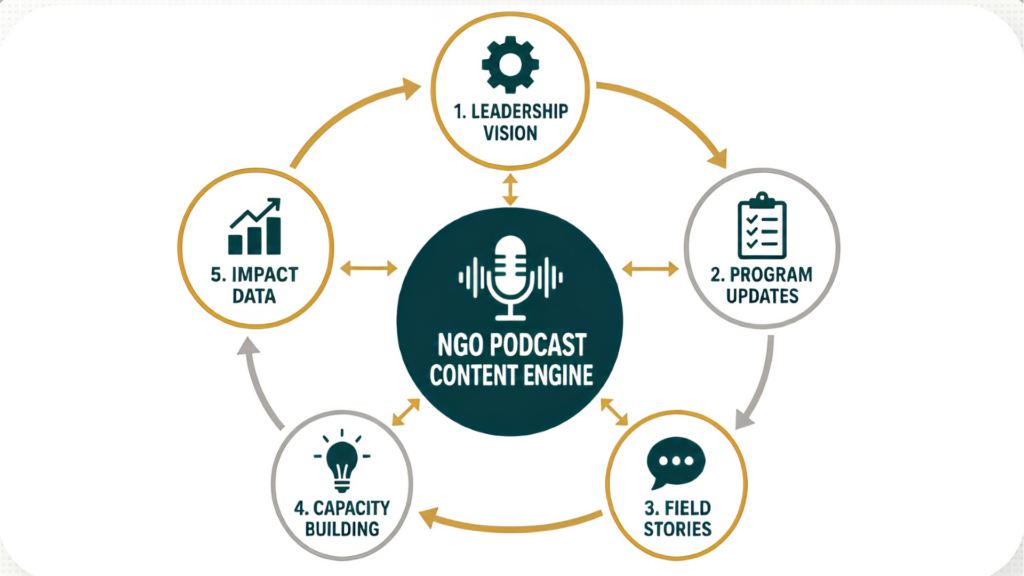
NGOs can use podcasts in ways that go far beyond visibility.
A podcast can support programs, training, awareness, internal learning, donor communication, and community engagement.
Here are practical ways NGOs can use podcasting in Syria.
1. Awareness Episodes
NGOs can create episodes around topics that people need to understand better.
These may include health awareness, child protection, education, mental health, women’s empowerment, livelihoods, community safety, legal awareness, or access to services.
The strength of a podcast is that it can explain the “why” behind the message.
Instead of saying, “This service is available,” an episode can explain who it helps, what problem it solves, what people often misunderstand, and how to approach it safely.
2. Field Stories With Dignity
Many organizations want to share impact stories, but impact storytelling must be handled carefully.
A podcast can share field stories without turning people into promotional material. It can focus on lessons, challenges, community voices, and human experience while protecting privacy and dignity.
The key is to avoid exploitation.
A strong episode does not need to expose someone’s pain to prove impact. It can show learning, resilience, and practical change in a respectful way.
3. Training and Capacity Building
Podcasts can support staff, volunteers, and community facilitators.
Instead of relying only on manuals or live workshops, organizations can create short internal podcast episodes that explain:
- Program values
- Field communication skills
- Safeguarding principles
- Community engagement methods
- Common field challenges
- Lessons from experienced team members
- How to respond to difficult questions
This can be especially useful when teams are spread across different areas.
4. Leadership Communication
NGO leaders often need to explain direction, priorities, and change.
A podcast can make leadership communication feel more human. Instead of sending another formal memo, leaders can speak directly to staff, volunteers, and stakeholders in a clear and calm way.
This does not replace formal communication. It supports it.
It gives people a chance to hear tone, intention, and context.
5. Donor and Partner Communication
A podcast can also help organizations explain their work to donors, partners, and professional audiences.
Not every donor update has to be a report. Some messages are stronger when heard through conversation: what changed, what the organization learned, what communities are asking for, and what responsible support should look like.
How Organizations Can Use Internal and Public Podcasts
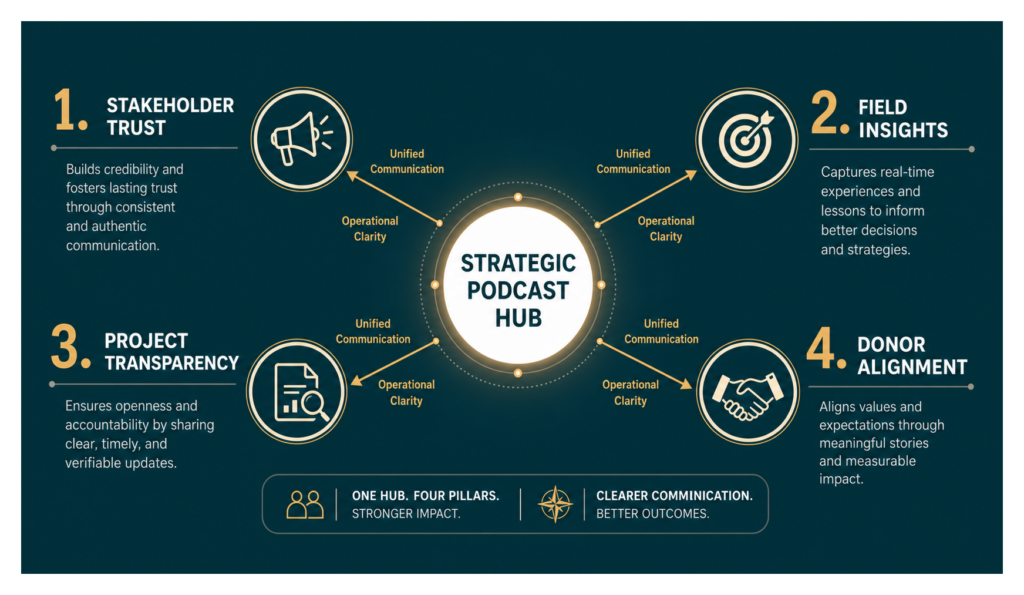
Podcasting in Syria is not only for NGOs.
Companies, universities, training centers, medical organizations, legal offices, professional associations, cultural initiatives, and media projects can all use podcasts in different ways.
Internal Podcasts
An internal podcast can help teams stay aligned.
This is useful for organizations with multiple branches, remote teams, volunteers, trainers, or field staff.
Internal podcast episodes can cover:
- Leadership updates
- Organizational culture
- Staff learning
- Department introductions
- Project updates
- Training refreshers
- Employee stories
- Lessons learned
Internal communication becomes stronger when people hear more than instructions. They hear context.
Public Podcasts
A public podcast can help organizations build authority and trust.
For example:
A medical clinic can create health education episodes.
A legal office can explain common legal risks.
A training organization can share career guidance.
A university can host conversations with professors and students.
A cultural initiative can document stories, memory, and local creativity.
A business organization can discuss entrepreneurship and market challenges.
The format changes depending on the goal. But the principle stays the same: the podcast should give people a reason to listen.
What Makes a Podcast in Syria Successful?
A podcast in Syria should not be built by copying shows from other markets.
The context is different. The audience is different. The trust barriers are different. The language choices may also be different.
A successful podcast needs several things.
1. A Clear Purpose
The podcast should not exist only because the format is popular.
It should answer one question:
What communication problem does this podcast solve?
Maybe it helps people understand services. Maybe it trains staff. Maybe it gives leaders a clearer voice. Maybe it builds public trust. Maybe it documents community knowledge. Maybe it helps professionals share expertise.
Without a clear purpose, the podcast becomes random.
2. A Defined Audience
A podcast “for everyone” usually feels too general.
The audience should be specific.
Is it for employees? Volunteers? Youth? Mothers? Entrepreneurs? Teachers? Medical workers? Local communities? Donors? Partners? Patients? Students?
The clearer the listener, the stronger the episode.
3. The Right Language and Tone
Language matters deeply in Syria.
Some episodes may work best in simple Modern Standard Arabic. Others may need Syrian Arabic. Some professional content may require a more formal tone. Some community episodes may need warmth and familiarity.
The tone should be chosen carefully.
Too formal, and people may feel distance.
Too casual, and the message may lose authority.
Too promotional, and trust may weaken.
The right tone feels human, respectful, and clear.
4. Strong Hosting
The host is not just a voice.
The host guides the listener. They ask the questions people are thinking about. They help the guest speak clearly. They keep the conversation focused. They make difficult topics easier to follow.
A weak host can make an important topic feel boring.
A strong host can make a complex topic feel understandable.
5. Responsible Storytelling
In Syria, storytelling must be handled with care.
Organizations should avoid exposing private details, overusing personal suffering, or turning community voices into campaign material.
Responsible storytelling respects people. It gives context without taking away dignity.
6. A Repurposing Plan
A podcast episode should not end after publishing.
One episode can become:
- Short clips
- Quote cards
- Social media posts
- Blog summaries
- Newsletter content
- Internal training material
- Community discussion prompts
- Donor communication pieces
This is where podcasting becomes more efficient. One good conversation can support many communication channels.
A Simple Podcast Planning Table for Organizations in Syria
| Goal | Podcast Format | Best Audience | Example Episode |
| Build community trust | Conversational episodes | Local communities | “What people should know before joining the program” |
| Train internal teams | Short learning episodes | Staff and volunteers | “How to answer difficult field questions” |
| Share expertise | Expert interviews | Public or professional audience | “What young entrepreneurs need to know before launching” |
| Support awareness | Educational episodes | Beneficiaries or communities | “Common myths about mental health support” |
| Strengthen leadership communication | Internal leadership talks | Employees and teams | “What our priorities mean for the next quarter” |
| Document stories | Narrative episodes | Public, partners, donors | “Lessons from the field: what we learned this year” |
Common Mistakes to Avoid
Podcasting can help organizations in Syria, but only if it is handled with care.
Here are the mistakes that can weaken the project.
Mistake 1: Starting Without Strategy
Recording episodes without a clear strategy usually leads to inconsistency.
The organization should define the audience, purpose, format, publishing rhythm, and approval process before recording.
Mistake 2: Sounding Too Institutional
Some organizational podcasts sound like reports being read aloud.
People do not listen to podcasts for that.
The conversation should feel structured, but still alive. The language should be clear. The host should ask real questions. The guest should sound human, not like a statement.
Mistake 3: Ignoring Local Sensitivity
Topics in Syria can carry emotional, social, legal, or political sensitivity.
Organizations must think carefully about what is said, who is included, how stories are framed, and what details should be avoided.
Mistake 4: Making Every Episode About the Organization
A podcast should not only say, “Here is what we did.”
It should serve the listener.
What can they learn?
What can they understand better?
What problem does the episode help them think through?
The organization’s work can appear naturally through value, not constant self-promotion.
Mistake 5: Publishing Without Distribution
A good episode is not enough.
Organizations need to plan where the episode will live and how people will find it. This may include social media, WhatsApp groups, internal platforms, partner newsletters, websites, community sessions, or training programs.
How Maha Fattoum Can Support Podcasting Projects in Syria
Podcasting in Syria needs more than technical production.
It needs editorial judgment, sensitive storytelling, strong hosting, and a clear understanding of how communication works when trust matters.
Maha Fattoum brings experience in media, journalism, podcasting, interviewing, and communication. This combination can help organizations and NGOs shape podcasts that sound thoughtful, professional, and close to people.
Her support can help with:
- Defining the podcast’s purpose and audience
- Creating the podcast concept and editorial direction
- Choosing the right format for the Syrian context
- Preparing hosts and guests
- Designing questions that create useful conversations
- Building episode structures
- Training internal teams
- Developing responsible storytelling guidelines
- Turning episodes into social, written, and internal content
- Helping organizations communicate with more clarity and confidence
For NGOs and organizations, the real value is not simply “having a podcast.” The value is having a podcast that people can trust, understand, and return to.
That requires care before the microphone is turned on.
Podcasting in Syria: Practical Ideas
Here are podcast ideas that can work for organizations, NGOs, and institutions in Syria.
For NGOs
- “What people should know before accessing support services”
- “Stories from the field: lessons without exposing identities”
- “How communities can participate in local initiatives”
- “Mental health conversations in simple language”
- “Education after disruption: what families need to know”
- “Youth voices: skills, work, and the future”
For Organizations
- “Inside the organization: what we are learning”
- “Leadership updates with context”
- “Employee stories across departments”
- “How our teams work with communities”
- “Lessons from projects that changed how we think”
For Professional Institutions
- “Legal awareness for everyday decisions”
- “Health education from local doctors”
- “Business and entrepreneurship in Syria”
- “Career conversations for young professionals”
- “Training talks for employees and volunteers”
Podcast Launch Checklist
Before launching a podcast in Syria, answer these questions:
- Who exactly is the podcast for?
- What problem will it solve?
- Should it be public or internal?
- What language or dialect is most appropriate?
- Who should host it?
- Who approves topics and episodes?
- What topics are sensitive and need careful handling?
- How will guests be prepared?
- How will privacy and dignity be protected?
- Where will the podcast be published?
- How will each episode be repurposed?
- How will success be measured?
If these questions are unclear, the podcast idea may still be strong. It just needs more preparation.
FAQ: Podcasting in Syria
What is podcasting in Syria useful for?
Podcasting in Syria can help organizations, NGOs, and institutions communicate more clearly, build trust, share knowledge, support training, explain services, and create more human conversations with communities and teams.
Are podcasts useful for NGOs in Syria?
Yes. Podcasts for NGOs in Syria can support awareness, field learning, staff training, leadership communication, donor updates, and community engagement. They work best when they are built around the listener’s needs, not only the organization’s activities.
Should podcasts in Syria be public or internal?
It depends on the goal. Public podcasts are useful for awareness, trust, education, and visibility. Internal podcasts are useful for staff alignment, training, leadership updates, and organizational culture.
What language should a Syrian podcast use?
The language depends on the audience. Some podcasts may need simple Modern Standard Arabic, while others may work better in Syrian Arabic. Professional or donor-facing content may need a more formal tone. The best choice is the one that feels natural and credible for the intended listeners.
Can one podcast episode be used in different ways?
Yes. A single episode can become short clips, written summaries, social posts, internal training material, newsletter content, or discussion prompts. This is why podcasting can be efficient for organizations with limited communication resources.
What makes podcasting in Syria different?
The context requires more care. Trust, sensitivity, language, privacy, and local realities matter. A podcast in Syria should not copy a generic format. It should be designed around the people it wants to reach and the communication problem it wants to solve.
