




A podcast can make an executive sound more human, more thoughtful, and more connected to the audience.
It can also do the opposite.
When the host is unprepared, when the questions feel generic, or when the conversation becomes too promotional, even a strong executive guest can sound distant. The episode may have the right title, the right microphone, and the right camera setup, but still fail to create a meaningful conversation.
That is why the role of a podcast host for executive interviews matters.
Executive podcasting is not only about asking questions. It is about leading a conversation with clarity, confidence, and purpose. A great host knows how to bring out the thinking behind a leader’s decisions, the story behind a company’s direction, and the human perspective behind professional success.
For C-suite leaders, founders, public figures, and senior executives, podcast hosting is a communication skill. It requires preparation, active listening, editorial judgment, and the ability to guide a conversation without making it feel controlled.
This is where Maha Fattoum’s experience becomes highly relevant. With her background in media, journalism, podcasting, interviewing, and communication, Maha can be a strategic partner for executives who want to host stronger podcast conversations and appear with more credibility, depth, and presence.
Why Executive Podcast Hosting Is Different
An executive podcast is not the same as a casual interview show.
The stakes are higher.
The host is often speaking on behalf of a brand, an organization, a leadership position, or a public reputation. Every question, reaction, and follow-up shapes how the audience sees the person behind the title.
A weak host may simply move from one prepared question to the next.
A strong host listens for meaning.
A weak host tries to sound impressive.
A strong host makes the guest clearer.
A weak host treats the episode like a performance.
A strong host treats it like a conversation with value.
This difference matters because executive audiences are usually busy, selective, and sensitive to empty talk. They do not want long introductions, vague ideas, or conversations that sound like corporate messaging. They want insight, perspective, honesty, and practical value.
That is why executives need more than basic hosting skills. They need a hosting approach that matches their level of leadership.
What Makes a Great Podcast Host for Executive Interviews?
A great executive podcast host is not necessarily the loudest person in the room. In fact, the best hosts often know when to step back.
Their job is not to dominate the episode. Their job is to shape the conversation.
Here are the qualities that matter most.
1. A Clear Purpose Before the Conversation Starts
The best executive podcast interviews begin before the recording.
Before an episode is planned, the host should understand the purpose of the conversation.
Is the goal to educate the audience?
Share a leadership lesson?
Explain a business shift?
Highlight a founder story?
Explore an industry challenge?
Strengthen the executive’s public voice?
Without a clear purpose, the episode can easily become scattered. The host may ask interesting questions, but the conversation will not build toward anything.
This is one of the most important podcast interview tips for executives: do not start with the guest bio. Start with the value of the conversation.
What should the listener leave with?
That answer should guide the episode.
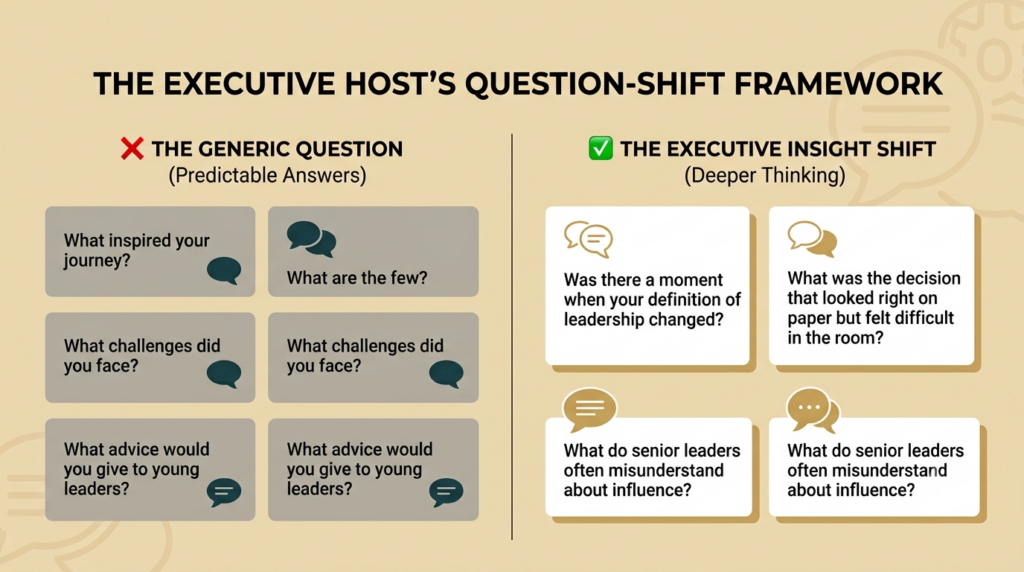
2. Questions That Sound Human, Not Scripted
Many executive interviews fail because the questions sound like they were written for a press release.
“What inspired your journey?”
“What challenges did you face?”
“What advice would you give to young leaders?”
These questions are not always wrong, but they are overused. They often lead to predictable answers.
A stronger executive host asks questions that are specific, thoughtful, and connected to real context.
Instead of asking:
“What makes leadership important?”
Ask:
“Was there a moment when your definition of leadership changed?”
Instead of asking:
“What challenges did the company face?”
Ask:
“What was the decision that looked right on paper but felt difficult in the room?”
Instead of asking:
“What advice do you have for executives?”
Ask:
“What do senior leaders often misunderstand about influence?”
The difference is subtle, but powerful.
Generic questions invite generic answers. Better questions create better thinking.
3. The Ability to Listen Beyond the Answer
Knowing how to host a podcast interview is not only about preparing questions. It is about knowing when to leave the prepared questions behind.
A guest may say something unexpected. They may pause before answering. They may mention a detail that deserves more attention. They may avoid a point that the audience would actually want explained.
A good host notices these moments.
They ask:
“Can you take us inside that decision?”
“What made that moment difficult?”
“You said something important there — can we stay with it for a moment?”
“What did you learn after that, not during it?”
“How did that affect the way you lead today?”
These follow-up questions are where the real value often appears.
For executives, this is especially important because leadership conversations can easily become polished. Active listening helps the host move from formal answers to real insight.
4. Control Without Interrupting the Flow
A podcast host must guide the episode without making the conversation feel rigid.
This is a delicate skill.
If the host controls too much, the episode feels forced.
If the host controls too little, the episode becomes unfocused.
Executive conversations need structure because the topics are often complex. A guest may move from leadership to finance, then to culture, then to market trends, then back to personal experience. The host’s role is to keep the conversation useful for the listener.
This can be done gently.
For example:
“That connects well to the next point I wanted to explore.”
“Let’s pause there, because I think this is useful for leaders listening.”
“I want to bring this back to the audience’s main challenge.”
“Before we move forward, can you give us a concrete example?”
These small interventions help the episode stay clear without making the host sound controlling.
5. A Strong Opening That Sets the Tone
The first minute of an executive podcast matters.
Many episodes lose listeners because the opening is too long, too formal, or too vague. The host spends several minutes reading biographies, thanking everyone, or explaining the obvious.
A better opening gives listeners a reason to stay.
A strong opening should quickly answer:
Who is this conversation with?
Why does it matter now?
What will the listener gain from it?
For example:
“Today’s conversation is not about leadership as a title. It is about the decisions leaders make when the easy answer is no longer enough. My guest has led teams through growth, uncertainty, and transformation, and we’ll explore what those moments teach us about executive judgment.”
This kind of opening gives the episode weight. It tells the audience that the conversation has a point.
6. The Confidence to Simplify Complex Ideas
Executives often speak in complex language because they deal with complex problems.
But podcast audiences need clarity.
A great host helps simplify without making the guest sound basic. This is one of the most valuable C-suite podcast tips: do not let complexity become distance.
When a guest uses technical language, the host can ask:
“How would you explain that to someone outside the industry?”
“What does that mean in practical terms?”
“Can you give us an example?”
“Why should leaders pay attention to this now?”
This does not weaken the conversation. It makes it more useful.
Executive podcasting is not about sounding complicated. It is about making important thinking easier to understand.
7. Presence, Not Performance
Some executives worry that hosting a podcast means becoming an entertainer.
It does not.
The best executive hosts are not trying to perform. They are present. They are curious. They are prepared enough to feel relaxed and confident enough to let the conversation breathe.
Presence shows up in small ways:
The host does not rush the guest.
They do not fill every silence.
They do not compete with the answer.
They do not try to prove how much they know.
They let the guest’s strongest ideas land.
This is one reason professional hosting support can make a major difference. Maha Fattoum helps executives develop this kind of presence through her experience in interviewing, media communication, and podcast hosting. Her role is not only to help with what to ask, but also how to listen, respond, and lead the conversation with credibility.
8. Turning the Episode Into a Strategic Asset
A strong executive podcast interview should not end when the recording ends.
Each episode can become part of a larger communication strategy.
One interview can create:
- Short video clips
- LinkedIn posts
- Newsletter content
- Blog articles
- Executive quote cards
- Internal communication material
- Event talking points
- Media positioning angles
But this only works when the conversation is designed with clear ideas inside it.
If the episode is vague, the repurposed content will be vague.
If the host asks better questions, the episode produces stronger moments.
This is why hosting and strategy are connected. A good host does not only think about the next question. They think about the value the conversation can create after publication.
Common Mistakes Executive Podcast Hosts Should Avoid
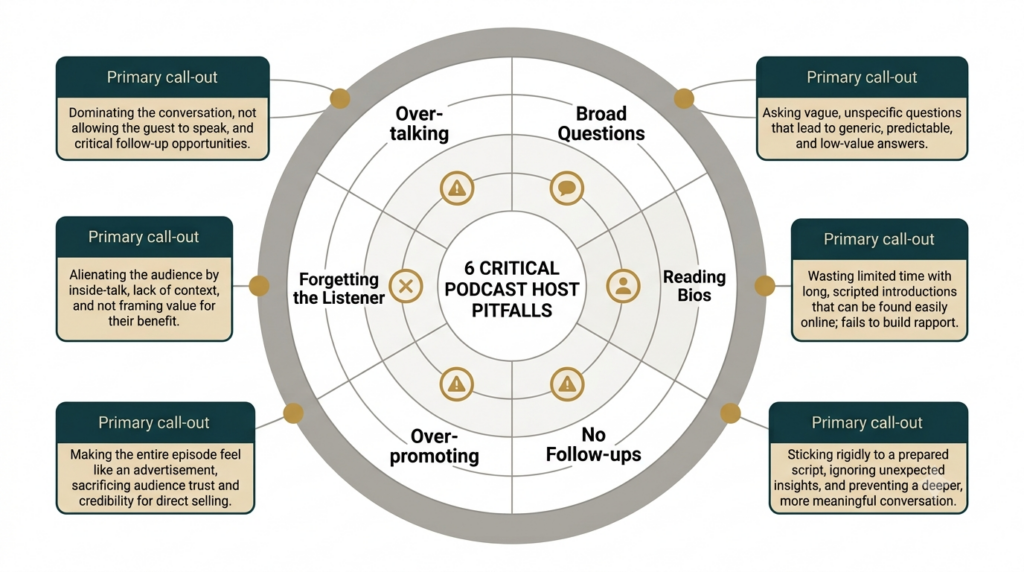
Even experienced leaders can struggle as podcast hosts. Public speaking, boardroom communication, and podcast hosting are related skills, but they are not the same.
Here are common mistakes to avoid:
Talking Too Much
The host should guide the conversation, not take it over. Long host monologues can make the guest feel secondary and reduce the listener’s interest.
Asking Questions That Are Too Broad
Broad questions often create broad answers. Specific questions make the conversation more memorable.
Reading the Guest’s Full Biography
A long bio can slow the episode down. The host should introduce only what matters for the conversation.
Avoiding Follow-Up Questions
The best moments usually come after the first answer. If the host never follows up, the interview stays surface-level.
Sounding Too Promotional
Executive podcasts should build trust, not feel like advertising. The value should come through insight, not direct selling.
Forgetting the Listener
The conversation is not only between the host and guest. The listener must always feel included.
How Maha Fattoum Can Support Executive Podcast Hosting
Executives often have powerful ideas, but they may need support turning those ideas into conversations that feel natural, focused, and valuable.
Maha Fattoum can support executives by helping them build a stronger hosting approach before they enter the recording room.
This may include:
- Defining the purpose of the podcast conversation
- Preparing stronger interview angles
- Creating thoughtful question flows
- Coaching the executive host on tone and presence
- Helping simplify complex ideas for listeners
- Improving follow-up question techniques
- Shaping the episode structure
- Making the conversation more useful for audience and brand positioning
This is where Maha becomes more than a podcast consultant. She can be a strategic communication partner for executives who want their podcast presence to reflect clarity, authority, and human connection.
Her background in media and interviewing gives her a strong understanding of what makes conversations work. She can help leaders avoid generic interviews and create episodes that feel more intentional, more intelligent, and more worth listening to.
Practical Podcast Interview Tips for Executives
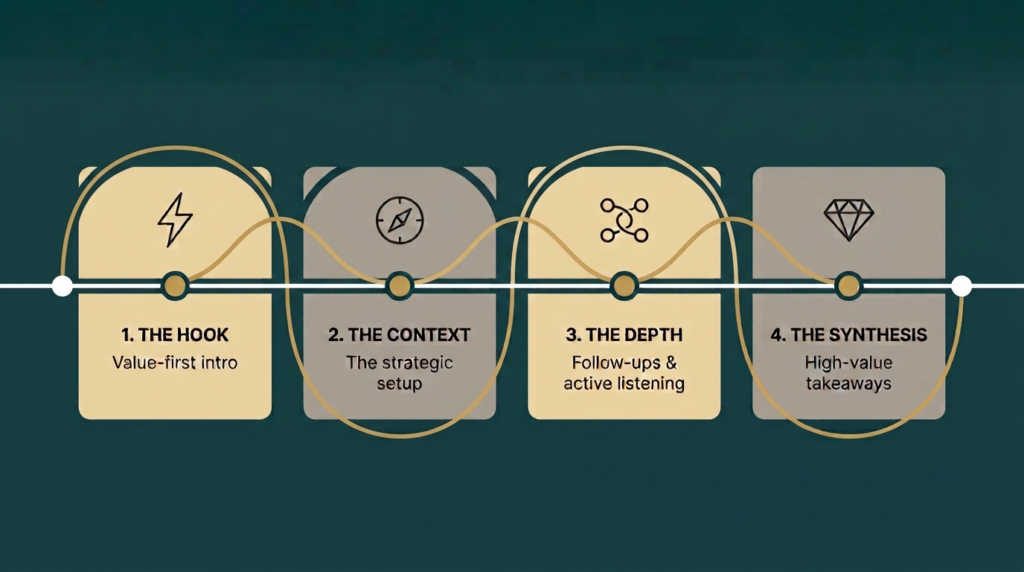
Before hosting your next executive podcast interview, use these tips:
Prepare the Conversation, Not Just the Questions
Know the guest, the topic, and the purpose. But do not over-script every moment.
Build a Narrative Arc
A strong episode should have a beginning, middle, and end. It should feel like the listener is moving through a useful conversation.
Ask One Question at a Time
Executives often ask multi-layered questions. This can confuse the guest. Keep questions clear and focused.
Use Follow-Ups Generously
Follow-ups create depth. They show the guest that you are listening and help the audience reach the real value.
Translate Ideas for the Listener
When the guest says something abstract, ask for an example. When they mention a strategy, ask what it looks like in practice.
End With Meaning
Do not end only with “Where can people find you?” End with a final insight, lesson, or reflection that gives the episode a strong closing moment.
Final Thoughts
A great podcast host for executive interviews does more than ask questions.
They create space for better thinking.
They help leaders sound clear without sounding rehearsed. They help guests go deeper without making the conversation heavy. They keep the listener in mind while protecting the purpose of the episode.
For executives, this skill is becoming more important. Podcasting is now part of leadership communication, thought leadership, and reputation building. The way a leader hosts a conversation can shape how their audience understands their judgment, values, and voice.
That is why executive podcast hosting should not be treated casually.
With the right preparation, structure, and guidance, every episode can become more than a conversation. It can become a leadership asset.
For executives who want to host with more confidence, clarity, and depth, Maha Fattoum offers the kind of media experience and strategic support that can turn podcast interviews into meaningful conversations worth remembering.