Do not hesitate to give us a call. We are an expert team and we are happy to talk to you.
How to Build Effective Podcast Team Inside Your Organization


July 6, 2026

Do not hesitate to give us a call. We are an expert team and we are happy to talk to you.
There is a moment many organizations reach before launching a podcast.
Someone in the team says, “We should start a podcast.”
The idea sounds good. It feels current. It gives the organization a chance to speak directly to its audience without waiting for media coverage, events, or campaign cycles. Soon after, the practical questions begin.
Who will host it?
Where will we record it?
Should it be filmed?
How often should we publish?
Who can we invite as guests?
All of these questions matter. But they are not the place to start.
The first question should be much simpler and much harder:
Why should this podcast exist?
That is where podcast strategy for organizations begins.
In 2026, podcasting is no longer just a content format. For organizations, it can be a trust-building platform, a leadership communication tool, a content engine, and a way to own conversations that matter to their audience. But only when it is built with a clear strategy.
Without strategy, a podcast becomes another content project that starts with enthusiasm and slowly disappears after a few episodes.
With strategy, it becomes part of how an organization communicates, educates, influences, and builds long-term credibility.
Many organizations underestimate podcasting because it looks simple from the outside.
Two people sit together. They talk. The episode gets published.
But a strong organizational podcast is not just a recorded conversation. It is a designed communication experience.
The topic is chosen for a reason.
The guest is invited for a reason.
The host asks questions in a certain way for a reason.
The episode title, intro, tone, structure, and call to action all serve a purpose.
That purpose does not appear by accident. It comes from strategy.
This is why a corporate podcast strategy should be created before production starts. The strategy gives the podcast its direction. It helps the organization know what to say, who to say it to, and how every episode supports a bigger goal.
A business podcast can be interesting and still fail. It can have good guests and still feel forgettable. It can be well produced and still not move the organization forward.
The difference is rarely the microphone.
It is usually the thinking behind the show.
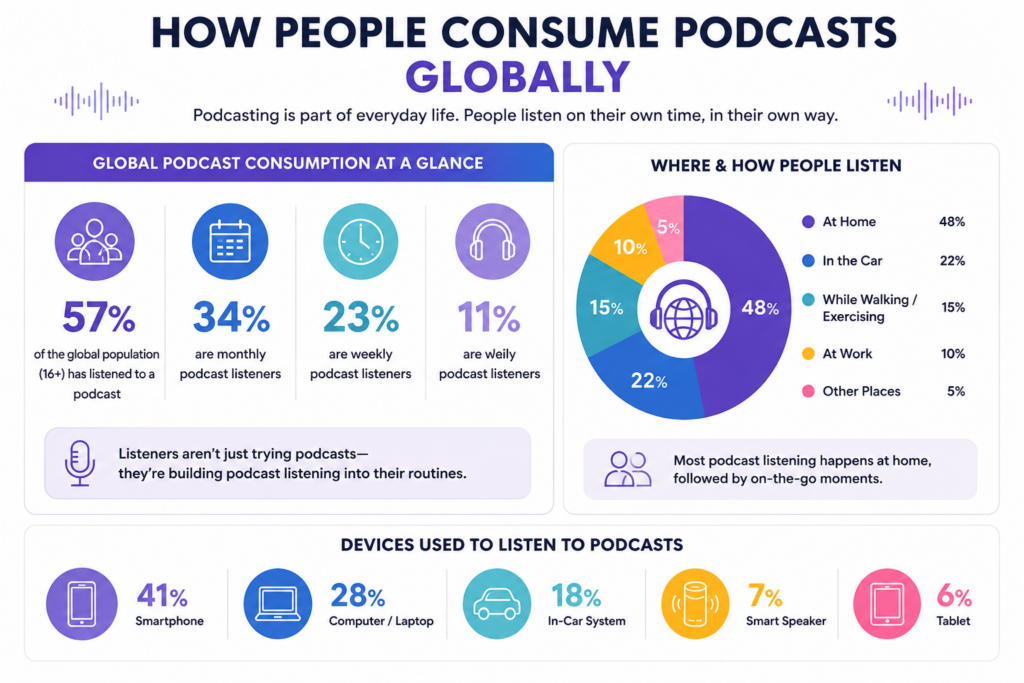
Organizations are not turning to podcasts only because the format is popular. They are turning to podcasts because communication has changed.
Audiences are tired of polished statements. They want depth. They want context. They want to hear real voices, not only official messaging.
A podcast gives organizations room to explain, not just announce.
It allows a company, institution, university, NGO, government initiative, or executive team to slow down the conversation and speak with more substance. This matters especially when the topic is complex, the audience is professional, or the organization wants to build authority over time.
A strong podcast can help an organization:
For many organizations, this is the real opportunity. The podcast is not only about being heard. It is about becoming associated with a clear point of view.
A podcast strategy for organizations is the plan that connects the podcast to the organization’s goals.
It is not simply a list of episode ideas.
It is the answer to questions like:
Who are we speaking to?
What do we want to be known for?
What conversations should we lead?
What should people trust us for?
What should the podcast do for the organization beyond getting listens?
How will this show support our brand, leadership, communication, or community?
This is where many podcasts become weak. They are created around topics, not around positioning.
An organization may say, “Let’s talk about leadership,” or “Let’s interview people in our industry,” or “Let’s create educational episodes.” That may be a starting point, but it is still too broad.
A good podcast strategy makes the idea sharper.
For example, instead of “a podcast about leadership,” the strategy might define a show about how leaders make decisions during transformation.
Instead of “a podcast about education,” the strategy might focus on the future of learning, told through the voices of experts, students, and institutional leaders.
Instead of “a business podcast,” it may become a platform where founders, executives, and specialists discuss the unseen challenges behind growth.
The more specific the idea, the stronger the podcast becomes.
It is easy to launch a podcast quickly. That is part of the problem.
Organizations can record a few episodes, upload them, create clips, and announce the show on social media. For a few weeks, everything feels active.
Then reality appears.
The team runs out of topic ideas.
The host is unsure how to guide the conversations.
The guests do not always fit the purpose of the show.
The episodes sound similar.
Promotion becomes inconsistent.
Leadership starts asking what the podcast is actually achieving.
This usually happens because the podcast was launched as a production task, not as a communication strategy.
A clear podcast launch strategy protects the organization from this. It forces the important decisions to happen early, before time, budget, and reputation are invested.
The best podcasts feel natural when people listen to them. But behind that natural feeling, there is usually structure.
Before recording the first episode, an organization should be able to answer these questions with confidence.
Not every organization needs the same reason.
Some launch a podcast to build thought leadership. Others want to educate their market, support internal culture, highlight social impact, strengthen executive visibility, or create a new content platform.
The clearer the reason, the easier every decision becomes.
A podcast built for internal culture will not sound like a podcast built for investors. A podcast designed for public awareness will not follow the same structure as one created for senior decision-makers.
This is why the first step in business podcast planning is not choosing the name. It is defining the role of the podcast inside the organization’s larger communication plan.
A podcast that tries to speak to everyone usually connects deeply with no one.
Organizations often have many audiences: customers, partners, employees, donors, students, investors, public stakeholders, media, and industry peers. A podcast cannot serve all of them equally.
It needs a primary listener.
That listener should be clearly described. Not only by job title or demographic, but by what they care about, what they struggle with, what they want to understand, and what kind of conversation would make them come back.
The podcast should feel like it was created for someone specific.
That is how trust begins.
This is one of the most important questions.
A podcast should help the organization own a space in the listener’s mind.
Maybe the organization wants to be known for serious industry insight. Maybe for leadership conversations. Maybe for public education. Maybe for giving voice to experts and communities that are often overlooked.
Whatever the direction, it should be intentional.
Without this clarity, the podcast becomes a collection of disconnected episodes. With it, every episode adds to a larger reputation.
The host is not a minor detail.
In many organizational podcasts, the host becomes the listener’s point of connection with the brand. The host sets the pace, asks the questions, creates comfort with the guest, and protects the quality of the conversation.
A good host does not simply read questions from a document. A good host listens. Follows up. Notices what matters. Brings clarity when the guest becomes too technical. Knows when to slow down and when to move forward.
For organizations, this role is critical because the podcast reflects the brand’s intelligence and communication style.
This is also where a podcast strategist experience becomes highly valuable. With a background in media, journalism, podcasting, interviewing, and communication, podcast strategist helps organizations think beyond the basic format and build conversations that feel professional, credible, and human.
Guest selection should never be random.
A well-known guest is not always the right guest. A senior title is not always enough. A good guest should support the podcast’s positioning and bring value to the audience.
Organizations should define guest criteria before launching.
Will the podcast feature internal leaders? External experts? Clients? Partners? Academics? Founders? Community voices? Policy makers? Industry specialists?
Each choice sends a message about what the podcast represents.
A clear guest strategy helps the organization avoid scattered conversations and build a stronger editorial identity.
There is no perfect podcast format for every organization.
Some organizations need a short educational format. Others need long-form interviews. Some need a hosted discussion. Others may benefit from a documentary-style approach, a panel format, or a leadership conversation series.
The format should be chosen based on the goal.
If the goal is to simplify complex topics, shorter structured episodes may work best.
If the goal is to build executive presence, thoughtful interviews may be more effective.
If the goal is to show institutional impact, storytelling may be stronger.
If the goal is to build relationships, guest-led conversations can create real value.
The problem begins when organizations copy formats without asking whether that format fits their purpose.
A successful corporate podcast strategy does not chase trends. It chooses the structure that best serves the message.
One strong podcast episode can do much more than live on Spotify or Apple Podcasts.
It can become a blog article.
A LinkedIn post.
A short video.
A newsletter section.
A quote card.
A website resource.
A training material.
A discussion starter for events.
A thought leadership asset for executives.
This is one of the biggest advantages of podcasting for organizations.
But it only works when the podcast is planned with repurposing in mind.
If the questions are weak, the clips will be weak.
If the topic is vague, the article will be vague.
If the episode has no clear message, the promotional content will feel empty.
Good repurposing starts before recording. It starts with choosing the right topic, shaping the angle, preparing the host, and knowing which moments the audience will care about.
This is why podcast strategy and content strategy should not be separated.
Downloads matter, but they do not tell the full story.
For organizations, podcast success may appear in different ways. A senior prospect may mention an episode during a meeting. A guest may become a partner. A leader may gain more visibility. A topic may start gaining traction on LinkedIn. An internal team may use the episode to explain the organization’s thinking.
These signals matter.
Useful podcast metrics for organizations may include:
The mistake is expecting a podcast to behave like a direct-response ad.
A podcast is usually a trust channel. It works by building familiarity, credibility, and authority over time.
That does not make it less valuable. It simply means it should be measured properly.
Organizations often know they want to start a podcast, but they do not always know how to shape it.
They may have the expertise. They may have access to leaders and guests. They may even have strong production support. But they still need someone who can turn the idea into a clear, professional, and sustainable podcast concept.
That is where a podcast strategist can support.
He/She brings together the skills that organizations need before and during a podcast launch: media thinking, editorial direction, podcast strategy, interview experience, communication judgment, and an understanding of how to turn conversations into meaningful content.
Podcast specialist work can help organizations define:
This is not only about making the podcast sound better. It is about making the podcast make sense.
For organizations, that difference is important.
A podcast should not feel like a side activity. It should feel connected to the organization’s voice, purpose, and credibility.
Yes. More than many organizations realize.
A podcast can build trust, but not if it has no direction.
It can support leadership, but not if the host is unprepared.
It can create content, but not if the episodes lack clear ideas.
It can strengthen reputation, but not if the positioning is weak.
In 2026, the organizations that benefit most from podcasting will not be the ones that simply launch. They will be the ones that know why they are launching, who they are speaking to, and what role the podcast plays in their wider communication strategy.
That is what a strong podcast strategy for organizations does.
It gives the podcast a reason to exist before the first episode is recorded.
Tag :
Share This :