

You’ve picked a topic, recorded a trailer, and chosen a name. Now you need someone to talk to.
So you open a blank email and type a name. Then you delete it. Why would anyone say yes to a show with eleven followers and no episodes?
That hesitation stops more podcasts than bad audio ever does. But it rests on a misunderstanding of why people accept invitations. Most guests aren’t counting your downloads. They’re asking a simpler set of questions. Is this person serious? Will the conversation be worth my time? Will I sound good?
You can answer all three without an audience. This guide covers how to find podcast guests, where to look, how to word an invitation, and how to handle the question that worries almost everyone: how do you get a big name on a small show?
Quick answer: Start with the episode you want to make, not a wish list of names. Describe the guest you need, look for them in places where they’re already visible, and contact them with a short, specific invitation that explains why them, what you’ll talk about, and how little effort it takes. Begin with people within a degree or two of your network, and build toward bigger names as you publish.
Why Guests Say Yes to Small Shows
Before tactics, it helps to see the invitation from the other side.
A person with real expertise gets pitched often. What makes them reply to you?
- They feel seen. A message that shows you know their work and have a specific reason for asking stands out from a copy-paste request.
- They expect a good conversation. Thoughtful questions are a bigger draw than a large listenership.
- The effort is low. One conversation, at a time that suits them, with no prep homework.
- They have something to gain. That might be a chance to talk about a project, reach a particular niche, or explain an idea they rarely get space for.
- They trust you’ll treat them well. Respect for their time and a fair edit matter more than people expect.
None of these depends on how many people already listen. They depend on how you approach the ask.
How to Find Podcast Guests: Start With the Episode, Not the Name
Many people build a list of famous names and then try to figure out what to ask them. It tends to produce vague outreach and vague episodes.
Reverse it. Start from what the listener needs, then work out who could help.
Ask yourself:
- What question does my listener keep running into?
- What experience would make that answer feel real, not theoretical?
- What kind of person has lived through it?
Then write a short profile of your ideal guest. It might look like this, using a hypothetical show about freelancing:
| Profile element | Example |
|---|---|
| Experience | Someone who moved from employee to freelancer and doubled their rates within two years |
| Willingness to be specific | Can talk about the mistakes, not only the wins |
| Communication | Explains things plainly to people outside their field |
| Fit | Their story would resonate with listeners who are about to make the same leap |
A profile like this changes your search. Instead of “famous freelancers,” you’re looking for “people who’ve done this particular thing and can describe it clearly.” That’s a bigger pool, and it’s far easier to reach.
If you can’t describe your ideal guest in a few lines, pause. The concept may need more shaping before you start sending emails.
Where to Look: Eight Places to Find Guests
Once you know who you’re looking for, you can search where those people are visible. Here are the places that tend to work for most shows:
| Where to look | What you’ll find | Tip |
|---|---|---|
| Your own network | Colleagues, former coworkers, clients, classmates, people you’ve met at events | Ask for introductions, not just your direct contacts |
| Professional platforms | People writing or commenting about your topic | Read their posts before you reach out so your message can refer to something specific |
| Communities and forums | Groups where your listeners already gather, and the experts they trust | Participate genuinely first; don’t just arrive with a request |
| Events and conferences | Speakers, panelists, and attendees on your subject | Speaker lists are useful, and so are the people in the audience asking sharp questions |
| Books, articles, and newsletters | Authors and writers who’ve explored your topic | Smaller authors often have more time and enthusiasm |
| Other podcasts | People who appear as guests on shows near yours | Their guest appearances show they enjoy the format and can talk well |
| Your own audience | Listeners, readers, and customers with a story to tell | Often the most overlooked source |
| Local and industry organizations | Associations, meetups, and chambers | Good for regional or niche shows |
A few notes on using these:
- Look for people who’ve talked before. Someone who has spoken at a meetup, written a thoughtful post, or been on another podcast is usually comfortable being interviewed.
- Use introductions when you can. A friendly connection often does more than the best-written cold email.
- Don’t ignore the less visible. The most useful guest is sometimes the person with deep experience and a small public profile.
How to Get Guests for a New Podcast When You Have No Audience
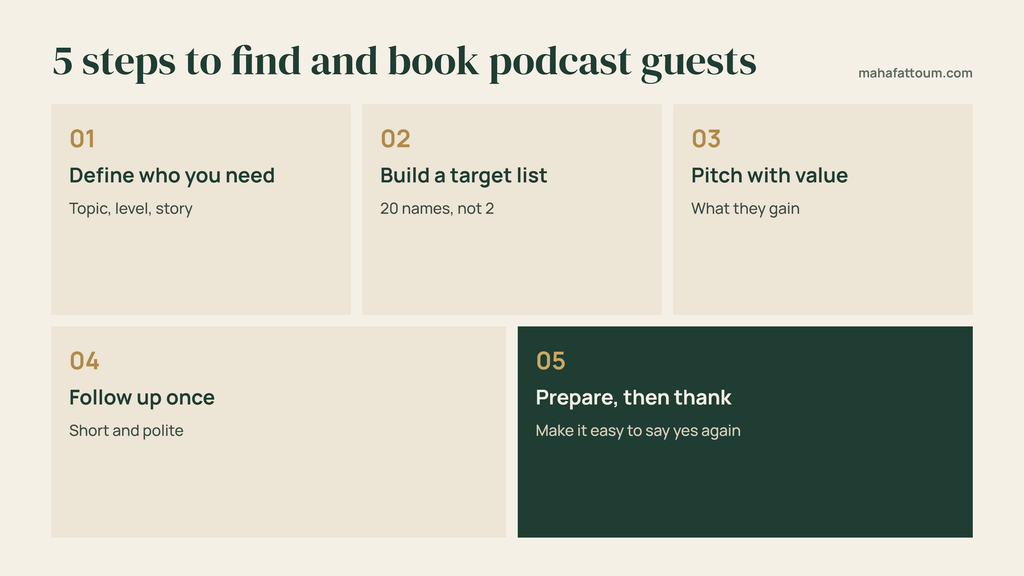
This is the question behind most searches: how do you get guests for a new podcast when nobody knows you yet?
The honest answer is to stop trying to compete on audience and start offering other things of value. You do have things to offer. Here’s what they look like:
| What you can offer | Why it matters to a guest |
|---|---|
| A thoughtful conversation | Many experts rarely get to discuss their ideas in depth |
| Preparation | You’ve read or listened to their work and ask real questions |
| Respect for their time | A clear start time, defined length, and no surprises |
| A focused audience | Even a small group of the right listeners can be more useful than a large, general one |
| A permanent recording | A conversation they can share and refer back to |
| A fair edit | They can trust that you won’t take quotes out of context |
Start closer to home
The easiest first guests are usually people who already know and trust you. They’re more likely to say yes, more forgiving while you find your feet, and often well connected to the next guest.
- Ask a colleague or friend with relevant experience.
- Invite a customer or community member with a good story.
- Interview someone you’ve learned a lot from, even if their name isn’t widely known.
These early conversations also give you something concrete to show later: recorded work you can point to.
Record a few episodes before you ask strangers
When you contact someone you don’t know, it helps to show what the show actually sounds like. Having a few episodes recorded, even if they aren’t published yet, lets you send a sample and answer the quiet question in their mind: is this real?
Be honest that you’re new
You don’t need to hide it. Something like “I’m just launching this show” is better than inflating the audience or avoiding the subject. Pair it with specifics: what the show is about, who it’s for, and why you thought of this person.
Think in steps
Many shows build up through a few levels:
- Friends and close contacts
- People one introduction away
- Relevant experts with modest followings who are generous with their time
- Better-known guests, approached with a catalog of episodes behind you
You don’t have to follow the ladder strictly. But it takes the pressure off the first few episodes and gives you material that makes later invitations easier.
How to Invite a Guest to Your Podcast: What a Good Message Contains
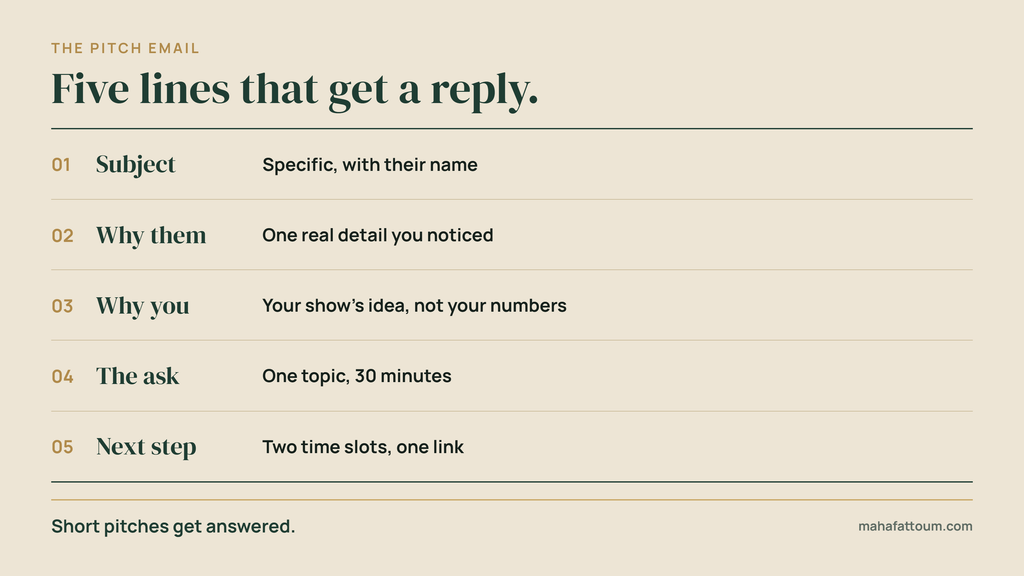
Writing the invitation is where good intentions often fall apart. People either write too much, say too little, or make the guest do the work.
A strong invitation is short and answers five questions quickly:
- Who are you? One line.
- What’s the show? One or two lines on the topic and the listener.
- Why this person? A specific reference to their work or experience.
- What would the conversation cover? A topic or question, not a vague “chat.”
- What’s the effort? Length, format, scheduling, and what you’ll handle.
Here’s a sample, with placeholders you’d replace. It’s written as a template, not a script to copy:
Subject: Invitation: a conversation about [specific topic]
Hi [Name],
I’m [your name], and I’m launching a podcast for [specific listener] called [Show name]. Each episode explores [one-sentence promise].
I read your piece on [specific article or project], especially the part about [specific detail]. It’s a question my listeners run into often, and I haven’t heard anyone explain it as clearly.
Would you be open to a [30 to 40 minute] conversation about [specific theme]? I’d send a short outline beforehand, record remotely at a time that suits you, and share the edit for your review before anything goes live.
If it helps, I can send a sample of the show or answer any questions first. And if the timing isn’t right, no problem at all.
Thank you for considering it,
[Name]
A few things make this work:
- It’s specific. The reference to their work shows you did your homework.
- It’s easy to say yes or no to. The effort is clear.
- It offers reassurance without pressure.
- It’s short enough to read on a phone.
Subject lines that get opened
Short and specific usually beats clever. Options:
- “Podcast invitation: [their topic]”
- “A question about [their project], for a podcast I’m launching”
- “Would you join a conversation about [topic]?”
Avoid “Quick question” and anything that sounds like a mass mailing.
Follow up, politely
People are busy, and silence rarely means no. A short follow-up after about a week is reasonable. Reference your first message in one line, restate the invitation briefly, and make it easy to decline. If there’s still no reply after a second try, let it go for now. You can try again after a few episodes when you have more to show.
Common mistakes in invitations
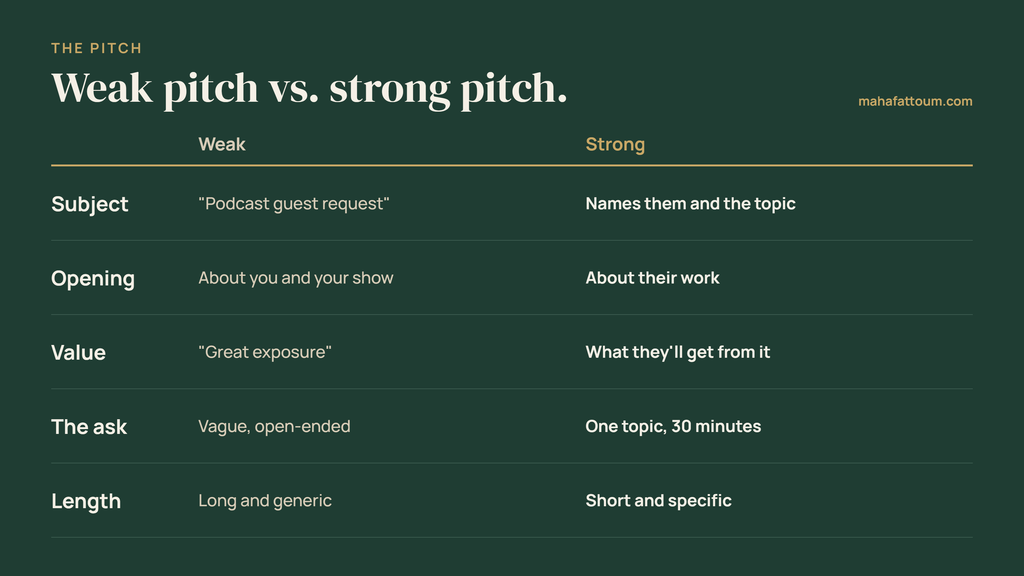
- Writing a wall of text. Long messages go unread.
- Opening with your show’s mission statement. Start with them, not you.
- Being vague about the topic. “Let’s chat” gives them nothing to say yes to.
- Making them do the work. Don’t ask them to propose times, topics, and technology. Offer a clear plan.
- Copy-paste outreach. People can tell, and it rarely lands.
- Overpromising reach. Don’t suggest your audience is larger than it is.
- Skipping the follow-up. One polite nudge often turns a missed email into a yes.
How to Get Big-Name Guests on a Small Podcast
Everyone wants to know this one, and it needs an honest answer: there’s no trick that guarantees a famous guest will say yes to a brand-new show. Plenty will say no, and plenty won’t reply. That’s normal and usually not about you.
But some approaches improve your odds. Here are the realistic ones.
1. Build toward them. A catalog of thoughtful episodes with credible guests is the strongest credential a small show has. The question changes from “Who is this?” to “Oh, they’ve talked with [respected person].”
2. Be specific about why them. Big names are asked about the same things repeatedly. An invitation built around a lesser-known project, an overlooked idea, or a question they rarely get can stand out.
3. Look for indirect routes. Introductions from someone they trust, a mutual contact, or an event where you can meet in person often carry more weight than a cold message.
4. Understand who guards their time. Many prominent people have an assistant, agent, or publicist. A polite, brief message to the right person, with a clear request and low effort for the guest, is more respectful and more effective than trying to bypass them.
5. Time the ask well. People tend to be more open when they have something new to talk about, such as a recent book, project, or launch. Referring to it shows you’re paying attention, though keep your questions broader than the promotion.
6. Make it easy. Offer a short conversation, flexible timing, and a plan that fits around their schedule. Some guests prefer audio only; others like the option to review.
7. Aim a little above, not far above. A guest who is a step or two more established than you is much easier to reach than a household name. They can also lead to the next one.
8. Accept that “no” is part of the process. Plan for several rejections or silences, and don’t build the whole season around a single dream guest.
Here’s how to calibrate your expectations:
| Approach | Likelihood of a reply | Notes |
|---|---|---|
| Warm introduction from a trusted contact | Usually the best odds | Worth asking your network who knows whom |
| Cold message with a specific, relevant reason | Variable | Quality of the message matters a lot |
| Generic mass email | Low | Rarely worth sending |
| Message after you’ve published relevant episodes | Better than starting cold | Your catalog is your credibility |
| Request tied to their recent project | Often improves attention | Keep it genuine, not opportunistic |
I haven’t included numbers here on purpose. Reply rates vary widely by field and by the quality of the message, so be wary of anyone who promises a precise figure.
Before the Interview: Booking, Preparing, and Making It Easy
Getting a yes is half the work. A smooth process also affects whether the guest enjoys the experience and recommends you to others.
Booking
- Offer two or three time slots and confirm the time zone in writing.
- Share a short confirmation with the date, length, platform, and any technical needs.
- Send a reminder a day or two before.
Preparing
Guests do their best work when they understand what to expect. A short outline helps, though it shouldn’t be a script. Include:
- The listener you have in mind
- The main themes you’d like to cover
- A couple of stories or experiences you hope they might share
- Anything you’d like them to avoid or not repeat from other interviews
Then do your own homework. Listen to a couple of their previous interviews to avoid repeating the same questions. The strongest moments often come from questions they haven’t been asked a dozen times.
Technical basics
- Ask them to use headphones and a quiet room if possible.
- Do a brief sound check before you start recording.
- Share a backup plan in case the connection drops.
Consent and rights
Agree in writing what you’ll do with the recording: where it will be published, whether clips may be shared, and whether they’d like to review it first. If the show is part of a business or involves sensitive material, it’s sensible to use a simple release form. Rules vary by country, so check what applies where you work, or ask a legal professional if the stakes are high.
After the episode
- Thank them promptly, and send the link when it goes live.
- Share clips they can post, with their permission.
- Stay in touch. Many early guests become advocates and introduce you to others.
Keep Track: A Simple Guest Pipeline
Once you’re contacting more than a few people, memory won’t be enough. A basic spreadsheet is plenty:
| Name | Why they fit | Contact route | Date contacted | Follow-up date | Status | Notes |
|---|---|---|---|---|---|---|
| (Example) | Lived through [specific experience] | Mutual contact | (date) | (date) | Invited / Confirmed / Declined | Topic ideas, scheduling notes |
Keep ten to fifteen names in progress at any time. That way a single “no” or silence doesn’t stall the show.
Where Guests Go Wrong (and How to Spot It Early)
Not every guest turns out to be a good fit. A few warning signs to watch for before you book:
- They only want to promote something, with no interest in the conversation itself.
- They’re reluctant to discuss specifics or personal experience.
- They’ve given the same answers in every interview you can find, and nothing suggests they’d go further with you.
- They hesitate on basic logistics, which can foreshadow trouble.
You don’t have to be harsh about it. If you’re unsure, a short pre-call can help you see how they talk about the subject and whether you’d enjoy the conversation.
It’s also worth knowing what makes someone a good interview, regardless of fame: real experience, the ability to explain it plainly, a point of view, and a story the audience can see themselves in. These qualities make an episode work. Name recognition doesn’t guarantee any of them.
Should Every Episode Have a Guest?
Not necessarily. Some shows mix guest episodes with solo ones, and this can reduce pressure while you build your guest list. If scheduling is slowing you down, you might alternate: one conversation, one solo reflection or Q&A.
The important thing is that the show keeps a clear identity either way. Listeners return for the perspective and the experience, not only the names.
Where AI Tools Fit
Tools can help with parts of the process: organizing your guest list, summarizing a guest’s previous interviews so you can prepare, drafting outlines, and cleaning up transcripts afterward.
Be careful with outreach, though. A message that obviously came from a template won’t land, and anything automated needs to be checked for accuracy before you send it. The research and the personal connection are the parts that actually persuade people, and those are still yours to do.
When It Helps to Get Outside Input
Sometimes the problem isn’t finding names. It’s the concept itself. A conversation with someone experienced can help if:
- You’ve had a podcast idea for months but haven’t contacted a single guest.
- You started a show and stalled after the first few episodes.
- You have a lot of knowledge but aren’t sure what kind of guests would complement it.
- You’re unsure whether your show should be interview-based at all.
A calm discussion, without the pressure of production deadlines, can help you clarify your audience, your format, and what kind of conversation you want to build.
Frequently Asked Questions
How to find podcast guests if I don’t know anyone in my field?
Start with the profile of the person you need, then look where those people are visible: professional platforms, community groups, event speaker lists, authors, and other podcasts. Read or listen to their work first so your message can be specific. And ask the people you do know who they’d recommend.
How to get guests for a new podcast with no audience?
Lead with what you can offer: a thoughtful conversation, careful preparation, and respect for their time. Begin with people in your network, record a few episodes so you have something to share, be honest that you’re new, and work upward as you publish.
How to invite a guest to your podcast?
Keep it short and specific. Say who you are, what the show is, why you’re asking them, what the conversation would cover, and what’s involved for them. Offer a sample and make it easy to say no. Follow up once if you don’t hear back.
How to get big-name guests on a small podcast?
There’s no guaranteed method. What helps: building a catalog of credible episodes, writing a highly specific invitation, using warm introductions, respecting gatekeepers, timing the request around something they’re working on, and aiming a step or two above your current level before reaching further.
How many guests should I line up before launching?
Having several episodes recorded or confirmed before launch removes pressure on your schedule. A handful is a practical target, and the exact number depends on your publishing pace.
What if a guest says no or doesn’t reply?
That’s common and usually not personal. Send one polite follow-up, then move on. You can return after you’ve published more episodes.
Should I pay or offer something in return?
Many guests are happy to appear for the conversation alone. If you’re approaching someone whose time is their business, it’s fair to ask what arrangements they prefer. Be clear and upfront about what you can and can’t offer.
Do I need a release form?
It’s a good habit to agree in writing on how the recording will be used. Requirements differ between countries and situations, so check local rules or seek legal advice if the show is part of a business.
Can I do a show without guests?
Yes. Plenty of shows are solo or co-hosted. If you’re deciding, think about whether your idea depends on other people’s experience, or on your own.
Start With One Good Conversation
Finding guests feels huge when you picture the whole season. It gets smaller when you think about one person and one honest invitation.
Define the guest your listener needs. Look where those people are visible. Write a short, specific message. Record a few conversations with people who say yes. And let the catalog you build do the persuading for the next round.
You don’t need an audience to start. You need a reason for the conversation, and the courage to send the email.