Picture two sales calls.
In the first, a salesperson phones a prospect who has never heard of the company. The first ten minutes go to explaining who they are and why anyone should trust them.
In the second, the prospect has spent a few commutes listening to a show the company makes. The episodes weren’t about the product. They were about the problems people in the prospect’s industry wrestle with every week. The call starts from somewhere very different.
That gap is what a brand podcast is really trying to close. It doesn’t promise instant sales. It builds a relationship that exists before the sales conversation begins.
But that doesn’t happen automatically. Some company shows find an audience that returns every week. Others turn into long advertisements that nobody finishes. The difference rarely comes down to the microphone or the studio. It comes down to decisions made before anyone hits record.
This guide covers what a brand podcast is, what it can realistically do for you, seven strategies for building an audience and turning attention into business, and what changes when your listeners are other companies.
What Is a Brand Podcast?
The idea is simple. Instead of telling people “buy from us,” the company says “here’s what we know, and it might help you.”
In practice, the company becomes a publisher. It has a show with a clear subject, a defined listener, and a voice people come to recognize.
It helps to separate three things that often get mixed up:
- A brand podcast: you create and own the show. You choose the topics, guests, tone, and schedule.
- Podcast advertising: you pay to place a message inside someone else’s show. You rent an audience that already exists.
- A podcast about brands: a show whose subject is marketing or business, which may or may not be owned by any company.
You can use more than one of these at once. But they solve different problems. Advertising buys attention quickly. A brand podcast builds a direct, ongoing relationship with your own audience, and that takes longer.
The Benefits of a Brand Podcast
Not every company needs a show. But when a company has something worth saying, audio can do things that other channels struggle to do in the same way.
Here are the benefits of a brand podcast that tend to hold up in practice:
- Trust through time. A written post takes a few minutes to read. A podcast episode can hold someone’s attention for twenty or thirty. That’s a lot of time with your company’s voice and way of thinking.
- Expertise shown, not claimed. You don’t have to announce that you’re experts. It shows in the questions you ask, the problems you tackle, and the honesty with which you discuss them.
- Access to attention in other moments. Many people listen while commuting, exercising, or doing chores, times when they wouldn’t sit down to read a long article.
- New professional relationships. Inviting customers, partners, and industry voices on the show opens doors that a cold email often can’t.
- Material that works elsewhere. One conversation can become clips, articles, newsletters, and sales enablement content.
Here’s how those benefits translate, and where to stay realistic:
| Benefit | How it shows up | A reasonable caution |
|---|---|---|
| Trust and familiarity | Prospects arrive already knowing your point of view | Builds slowly, and is hard to attribute to a single episode |
| Expertise on display | Sales teams and customers refer back to episodes | Only works if the content is genuinely useful |
| Relationships | Guests become partners, advocates, or referrers | Depends on choosing guests for value, not only for name recognition |
| Reusable content | Episodes feed articles, clips, and email | Requires planning, not just recording |
| Audience you own | A direct channel not controlled by a social algorithm | You still have to earn listeners; they don’t appear on their own |
Notice what isn’t on that list: guaranteed sales. A brand podcast can contribute to revenue, but it’s usually one factor among several, alongside your website, sales conversations, and word of mouth.
Is a Brand Podcast Right for Your Company?
Before you plan anything, ask a few honest questions. Your answers could save you months.
Signs the idea fits:
- You have real knowledge or experience that a specific audience would benefit from.
- Customers keep asking questions that need more space than a social post allows.
- Someone on your team can hold a natural, useful conversation in front of a microphone.
- The company can commit to staying with it, not just producing two episodes and stopping.
Signs to pause and rethink:
- The main reason is “our competitors have one.”
- Nobody owns the show internally, so it belongs to everyone and therefore no one.
- Leadership expects each episode to produce sales right away.
- There’s no plan for what happens after the first few recordings.
If your answers are mixed, that doesn’t mean no. It might mean starting smaller. A short season of six to eight episodes lets you learn what your audience responds to before you commit to a long-running show. That range is a practical testing window, not a rule.
Brand Podcast Strategy: Start With Three Questions
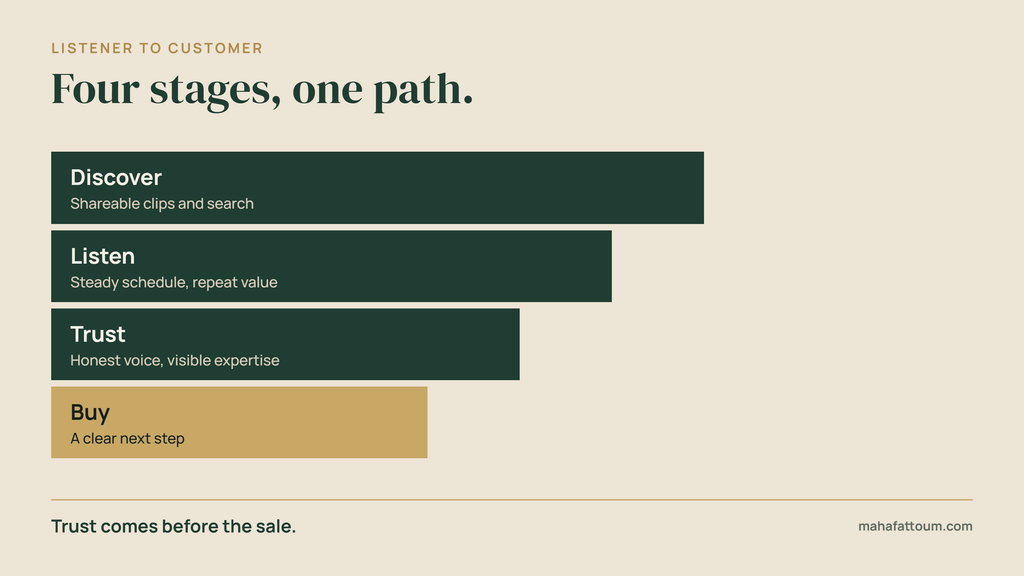
“Do we really need a strategy before we begin?” It’s one of the most common questions teams ask.
In this context, strategy doesn’t mean a thick document filled with charts. It means clarity on three things.
1. Why does the show exist?
Do you want to build authority in your field? Support the sales team? Attract talent? Build relationships with experts and partners? A show can serve several goals, but picking one primary goal keeps decisions consistent.
2. Who is it for?
“Anyone interested in business” is not an audience. “Operations managers at mid-sized logistics companies who’ve just inherited a software migration” is much closer. The more precisely you can describe the listener, the easier it is to choose topics, questions, and examples.
3. What should happen after someone listens?
Should they remember one idea? Come back for the next episode? Download a resource? Reach out when they have a related problem? The answer shapes the episode’s structure and the call to action at the end.
A strong brand podcast strategy starts before you’ve picked a name, designed a logo, or booked a studio. It’s much easier to change direction on paper than after six recorded episodes.
One exercise that helps: write your promise to the listener in a single sentence. For example, “In every episode, we help [specific audience] understand [specific decision] through real experiences.” If you can write that sentence, you can test every new idea against it. If you can’t, the concept still needs work.
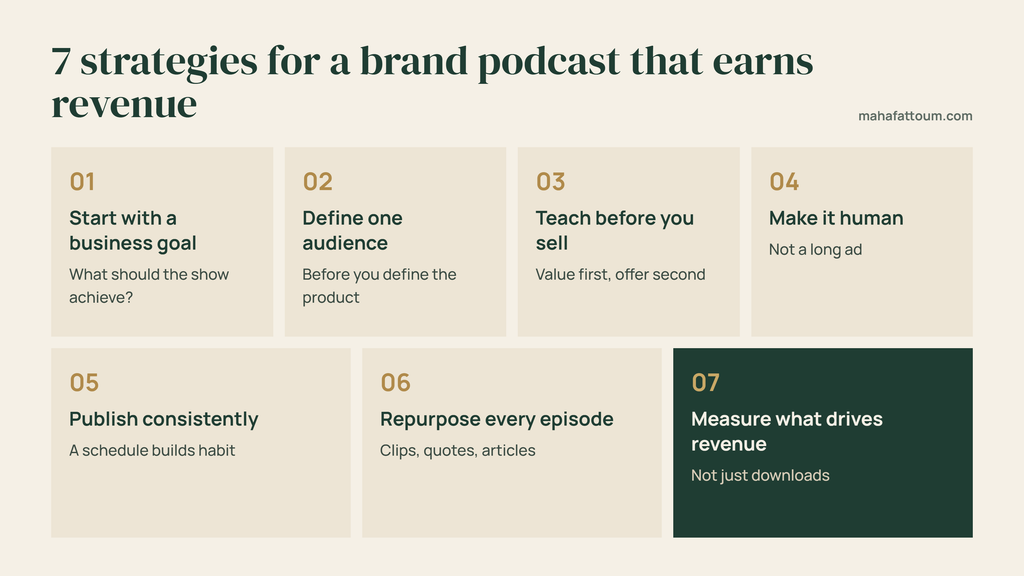
7 Strategies to Build Your Brand Podcast Audience and Drive Revenue
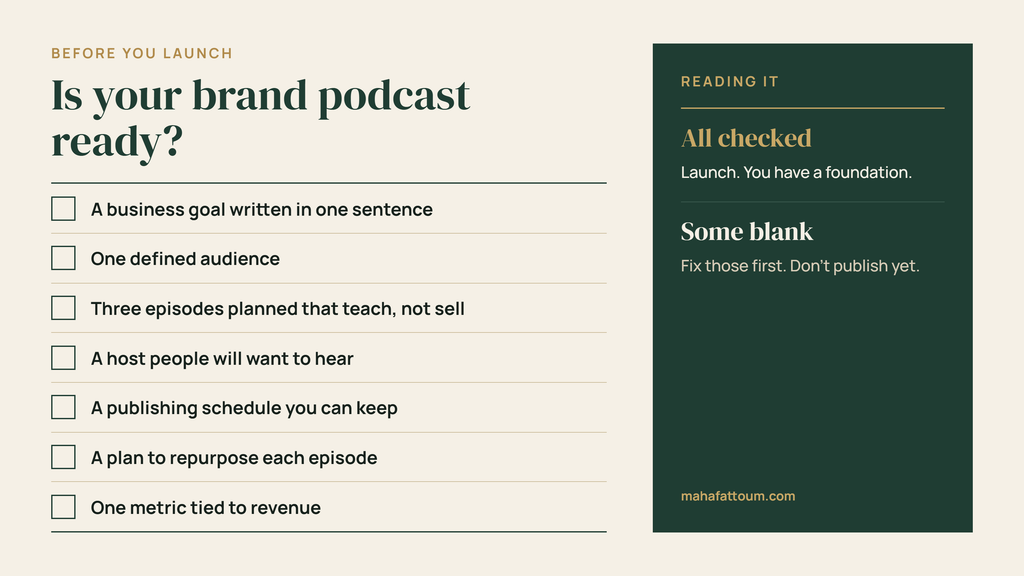
These aren’t growth hacks. They’re practical decisions that separate shows people return to from shows that simply exist.
1: Start with your customer’s problem, not your product
The quickest way to lose a listener is to open every episode talking about yourself.
Ask instead: What do customers ask us again and again? What decisions do they struggle with? What do they need to understand before they’re ready to buy?
Imagine a company that sells payroll software. An episode on “what to look for in a payroll system” sounds like a sales pitch. An episode on “the compliance mistakes small teams make when they hire their first employees” helps the listener whether or not they ever buy anything. The second approach earns trust. The product can still appear, but as a natural part of a solution, not the starting point.
Try this: ask your sales and support teams to write down the ten questions they hear most. Choose the ones that deserve a real conversation. You may find your first season outlined without a brainstorm.
2: Pick one audience and serve it well
A show for everyone usually resonates with no one.
When you choose a specific audience, you can use their language, offer examples from their world, and skip explanations they don’t need. A show for chief financial officers will sound different from a show for founders who handle their own bookkeeping, even if the topic is the same.
Write a short description of one listener. What’s their role? What worries them? What decision are they trying to make? Then show it to the people who talk to customers every day and ask, “Does this person actually exist among our customers?”
3: Give the show a human voice
People don’t build relationships with logos. They build them with people.
A brand podcast needs a host who can lead a conversation naturally, ask honest questions, and listen when a guest says something worth pausing on. That might be the founder, a subject-matter expert on your team, or an outside host.
A common mistake is choosing the host because they’re available, not because they’re good at it. And the best hosts aren’t necessarily those who talk the most. Sometimes a short question or a well-placed pause does more than any prepared speech.
Before settling on a host, record a short test conversation. Listen to it as if you’d never heard of your company. Would you want another episode?
4: Choose guests for value, not for name
Famous names can be tempting, especially when you’re starting out.
But fame alone doesn’t make a good episode. Someone who has lived through a specific experience, and can explain what they decided and what they’d do differently, may give your listeners more than a well-known guest repeating familiar ideas.
Before inviting anyone, ask:
- Do they have real experience with this topic?
- Can they explain it clearly to someone outside their field?
- Do they have a perspective listeners won’t hear everywhere?
- Will our audience see something of themselves in their story?
And prepare guests without scripting them. Tell them who’s listening, what you hope the episode will offer, and what kinds of stories tend to land. Knowing a subject well isn’t the same as knowing how to translate it for a listener, and a short pre-call helps bridge that gap.
5: Plan what happens after the episode ends
Many companies plan what the host will say and forget to plan what the listener will do next.
You don’t need a sales pitch in every episode. A natural next step works better:
- A related article that goes deeper
- A free checklist or guide mentioned in the episode
- A newsletter that continues the conversation
- A simple invitation to ask a question or start a conversation
Imagine a company that makes inventory software and records an episode about common stock-counting mistakes. It might invite listeners to download a short audit checklist. If the listener finds it useful, they may look at what else the company offers. They didn’t become a lead because they heard an ad. They moved forward because the content helped.
Keep it to one clear invitation per episode, and send it to a page that matches the topic. A unique link for each episode makes it easier to see where visitors come from, though people may also return later through other channels.
6: Reuse every episode
An episode that’s published once and forgotten is a lot of effort for limited return.
A good conversation usually contains ideas that deserve to reach people who don’t listen to podcasts at all. One episode can become:
- A short clip answering a specific question
- An article summarizing the key ideas, with sources and links
- A social post debating a guest’s opinion
- An email expanding on a point from the discussion
- Material the sales team uses to answer common objections
The goal isn’t to repeat the same recording everywhere. It’s to pull out the best ideas and present them in the format each audience prefers.
A word of caution: an automatic transcript pasted online isn’t a good article. Conversations ramble, repeat, and assume context. Edit for the reader. Reorder ideas, remove repetition, and add headings and sources.
7: Measure what matches your goal, and be patient
Download numbers alone don’t tell you whether the show is working.
A show meant to build brand awareness needs different measures than one meant to support sales or attract talent. Here’s a starting point:
| Goal | What to track | Notes |
|---|---|---|
| Build trust and familiarity | Repeat listeners, episode completion, quality of replies | Slow to appear and builds over time |
| Generate leads | Visits to episode pages, resource downloads, related inquiries | Use a distinct link per episode |
| Support sales | Whether the team uses episodes in conversations; what prospects mention | Requires input from sales |
| Build relationships | Partnerships or collaborations that began with a conversation | Quality matters more than quantity |
| Improve content efficiency | Pieces created from each episode and how they perform | Shows how well you reuse material |
Give it time. Listeners may need a few weeks or months to find the show and decide to stay. A prospect might hear several episodes before ever reaching out. Review results in stages, and don’t confuse listens with commercial value. A smaller audience made up of the people you most want to reach can be worth more than a large audience with no connection to your business.
B2B Podcast: What Changes When Your Listeners Are Buyers
A B2B podcast follows the same principles as any other brand show, but the context shifts in a few important ways.
Business purchases usually involve longer decisions, more people, and more risk. The person listening may not be the person who signs the contract. That changes what the content needs to do.
| B2B podcast | Consumer-facing brand podcast | |
|---|---|---|
| Decision cycle | Often longer, with several people involved | Often shorter and more individual |
| What the listener wants | Help making a defensible decision, and expertise they can trust | Entertainment, inspiration, or personal usefulness |
| Role of content | Educate, reduce uncertainty, build credibility with a team | Build affinity and routine |
| Typical topics | Industry shifts, practical challenges, real customer experiences | Lifestyle, interests, stories |
| Useful call to action | A guide, an audit, a conversation with an expert | A product, a community, a subscription |
A few practical points follow from this:
- Make it useful for a team. Episodes that a listener can forward to a colleague (“you should hear this part”) work harder than those that only appeal to one person.
- Use real customer experiences. Hearing how a peer solved a problem carries weight with business audiences. Always get permission before featuring anyone.
- Respect the listener’s time. Busy professionals tend to appreciate focused episodes with a clear takeaway more than long, rambling ones.
- Be patient with attribution. Because business buying involves several people and steps, a podcast may influence a decision months before a deal appears. Ask new contacts how they heard of you and whether they’ve listened.
Common Brand Podcast Mistakes
Some patterns come up again and again. Knowing them in advance can save a lot of rework.
- Turning the show into a long advertisement. If every episode is about the product, listeners have no reason to return.
- Speaking to everyone. A show without a defined audience tends to lose its focus.
- Choosing guests by fame alone. A big name might attract attention to an episode, but value is what makes people finish it.
- Starting with equipment instead of the idea. Buying microphones is easier than answering “why does this show exist?”
- Skipping promotion. Even a great episode needs a plan so the right people can find it.
- No clear owner. Without one person responsible for decisions and follow-through, episodes stall between teams.
- Stopping too soon. An audience takes time to form. Quitting after a few episodes can stop you from learning whether the idea works.
- Corporate tone. The formal language of a press release rarely works in conversation. Talk like people.
Most of these mistakes trace back to a lack of clarity at the start, more than to a lack of budget.
Should a Brand Podcast Be Audio or Video?
With video podcasts everywhere, many teams ask this early. Start with your audience and your content, not the technology.
If your show depends on facial expressions, chemistry between speakers, or visual demonstrations, video may add real value. It also makes it easier to cut short clips for social platforms. If your audience mostly listens while commuting or working, audio-only may be enough.
You can also start with audio and add video once you know the show has an audience worth investing in. Whichever you choose, remember that people rarely recall which camera you used. They remember the story they heard and the idea they took away.
Where AI Tools Help, and Where They Don’t
AI tools can take on some of the time-consuming parts of production: transcribing episodes, organizing ideas, suggesting titles, flagging moments worth clipping, and drafting descriptions. Others help clean up audio and reduce background noise.
What they can’t do is live a guest’s experience, notice when an unexpected answer deserves a follow-up, or supply the expertise that makes your conversation different from a hundred similar ones. Treat them as production assistants, not replacements for thinking and editing.
And always review what they produce. Check names, numbers, and any statement that could change meaning when taken out of context.
When Outside Help Makes Sense
Sometimes the obstacle isn’t equipment or recording skills. The show’s concept just isn’t clear yet. Working with a specialist can be useful if:
- A podcast idea has been discussed internally for months without turning into a plan.
- You started a show and stopped after a few episodes.
- You have valuable knowledge but aren’t sure how to turn it into episodes.
- You need help defining the format, choosing a host, or shaping the guest list.
- You want consistent content without overloading your team.
This doesn’t mean handing the whole project to someone else. Often the best arrangement is one where your team keeps its knowledge and closeness to the audience, while a partner helps with planning, production, and distribution.
Whichever route you take, start by discussing the goal and the audience before you talk about studios and cameras.
Frequently Asked Questions About Brand Podcast
How much does it cost to start a brand podcast?
The cost depends on the production quality, equipment, editing requirements, and whether you handle the work internally or hire a podcast production agency. A simple audio podcast can start with a modest budget, while professionally produced shows involving video, custom branding, and guest coordination require a larger investment.
How often should a brand podcast release new episodes?
Consistency matters more than frequency. Weekly, biweekly, and monthly schedules can all work, depending on your team’s resources and your audience’s listening habits. Choose a publishing schedule you can maintain without sacrificing content quality.
What is the ideal length for a branded podcast episode?
There is no universal ideal length. Short episodes of 15–20 minutes may work well for focused insights, while interviews and in-depth discussions may need 30–60 minutes. The best length is the time needed to deliver useful information without unnecessary filler.
How do you measure the success of a branded podcast?
Success can be measured through downloads, listener retention, repeat listeners, website visits, newsletter sign-ups, and qualified business inquiries. The most useful metrics depend on whether the podcast aims to build awareness, strengthen relationships, or support lead generation.
Should a company produce its podcast in-house or outsource production?
In-house production offers greater control and can be cost-effective when the team has the necessary skills and time. Outsourcing can provide access to experienced producers, editors, and audio specialists. The right choice depends on your budget, internal capabilities, and desired production standards.
Can brands repurpose podcast episodes into other marketing content?
Yes. A single episode can provide material for blog articles, social media posts, short video clips, newsletters, and educational resources. Repurposing helps brands extend the usefulness of each conversation while reaching audiences who prefer different content formats.
Build Something Worth Returning To
A brand podcast isn’t a shortcut to sales. It’s a way of earning attention and trust by being genuinely useful, repeatedly, to people who need what you know.
Start by choosing the listener. Build the show around their problems. Give it a voice people want to hear, a plan for what comes after the episode, and enough patience to let the audience form.
If you do those things consistently, the show stops being just another channel. It becomes a place where people get to know your company before they ever need to hire it.