Picture the usual podcast setup: two chairs, two microphones, one person asking and one answering.
Now picture the other kind. One voice, one mic, and a listener who feels like they’re getting a long, thoughtful message meant for them. That’s a solo podcast, and it’s a format a lot of people try after they get tired of chasing guests and juggling calendars.
It also scares people off. Who wants to hear just me for twenty minutes? What happens when I run out of things to say? Wouldn’t this be easier with someone else in the room?
Those worries are reasonable. A show with one voice isn’t the easy version of podcasting. It trades one set of problems for another. This guide covers what changes when you go solo, how to start, which formats work, and how to grow a podcast without guests to share your episodes. You’ll also find a format table and a short self-check to use before you record anything.
Quick definition: A solo podcast is a show hosted by one person, with no regular guests or co-hosts. The host carries each episode alone, usually by telling stories, teaching an idea, commenting on developments in a field, or answering listener questions.
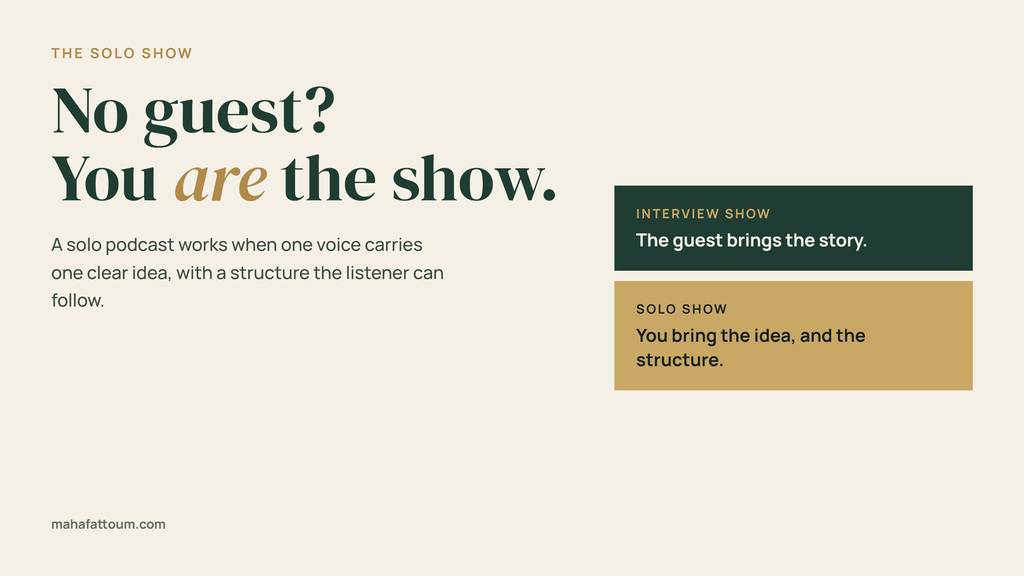
Is a Solo Podcast Easier Than an Interview Show?
It’s easier to organize and harder to carry.
The logistics really are lighter. You don’t coordinate time zones, wait on replies, or deal with a guest who cancels an hour before recording. You record when you’re ready.
But think about what a guest actually does in an interview. They bring stories you haven’t heard. They disagree with you. They take over the talking for a few minutes so you can think. The conversation moves because someone else is pushing it.
Remove the guest and all of that falls on you. You supply the ideas, the pacing, the energy, and the reason someone should stay past the first few minutes.
So a solo format suits people who already have something to say. If you can finish the sentence “here’s what I think, and here’s why,” you have a starting point. If your plan is “I’ll work it out as I talk,” expect the show to feel thin quickly.
Why People Choose a Solo Podcast (and Which Reasons Don’t Hold Up)
There are good reasons to go solo, and some that look good but aren’t.
Solid reasons
- You have a perspective or body of experience you want to explain in depth.
- You want control over topic, tone, and schedule.
- You’re building a personal or professional voice rather than hosting conversations.
- Your material works better as a single, continuous explanation than as a dialogue.
Shaky reasons
- “I don’t know who to invite.” That’s a different problem, and going solo doesn’t fix it.
- “Interviewing makes me nervous.” Fair, but talking alone into a microphone has its own kind of awkwardness.
- “It’ll be less work.” It’s less coordination, not less preparation. You still need ideas, structure, and stories for every episode.
A show with no shape is the most common reason a solo format falls apart. When every episode starts with “what should I talk about today?”, listeners can tell, and it gets harder to keep going.
What Makes a Solo Podcast Worth Listening To?
You don’t need a radio voice or a studio. The shows that hold attention tend to have these qualities:
- A clear promise. Within the first minute, the listener knows what kind of thing they’re getting and why it’s relevant to them.
- A point of view. The host isn’t summarizing the internet. They’re saying what they think, based on what they know or have done.
- Specific stories. “Communication matters” is forgettable. A particular situation, with details and a result, sticks.
- A shape. The episode has a beginning, a turn, and an ending. It doesn’t wander until it runs out of steam.
- A real person on the other end. It sounds like someone talking to you, not performing for a crowd.
None of these requires a guest, and none requires expensive gear. They require preparation and honesty.
[Optional: add a short example here from a solo show you admire or a show you’ve produced, and say what made it work. Real examples from your experience will make this section stronger than anything generic.]
How to Start a Solo Podcast: 7 Steps in a Sensible Order
If you’re wondering how to start a solo podcast without getting buried in gear reviews, this order helps. Notice the microphone comes last.
1. Decide who you’re talking to
“Anyone interested in marketing” isn’t a listener. Try picturing one specific person: a new manager who feels out of their depth, a freelancer who suspects they’re undercharging, a parent trying to understand how schools work today. When you can picture them, your examples sharpen and your tone settles.
2. Write the promise in one sentence
Finish this: “If you listen to this show, you’ll be able to ______.” If it takes a paragraph to explain, the idea isn’t clear yet. That’s useful to know before you record anything.
3. Pick a topic you can sustain
Write down twenty possible episode titles. If they come easily and feel different from each other, the topic has room. If you stall around eight, or every title is a slight rewording of the last, the topic may be too narrow or the concept needs more work.
4. Choose a format and stay with it for a while
A format gives each episode a skeleton, so you aren’t reinventing the show every week. The next section covers options.
5. Outline your first ten episodes
For each one, write a working title, the core question, and two or three stories or examples. These aren’t scripts, just enough structure that you never sit down wondering what to say.
6. Record a rough episode for yourself
Don’t publish it. Listen back and notice where you rush, where you drift, and where you sound most like yourself. Almost everyone feels awkward hearing their own recording at first, and that feeling tends to fade with repetition.
7. Then pick your equipment
A decent microphone, headphones, and a quiet room with soft surfaces (curtains, a rug, a sofa) are enough to begin. Listeners tend to forgive a plain voice more readily than muddy or echoey audio, so it’s worth testing a minute of sound before each session. You can upgrade later if the show earns it.
Before you commit, run this quick check:
| Question | A strong answer sounds like | A warning sign |
|---|---|---|
| Who is it for? | You can describe one specific listener | “Everyone interested in the topic” |
| What’s the promise? | One clear sentence | A vague mission statement |
| Can you fill 20 titles? | Yes, quickly, and they feel varied | You stall around ten |
| Do you have stories? | Yes, from your own experience | Mostly summarizing other people |
| Can you keep the pace? | A schedule you can maintain | Big promises, little time |
| Will you enjoy talking alone? | Your test recording felt natural | It felt like a chore |
If two or more rows land in the warning column, spend more time on the idea before you buy anything.
Solo Podcast Format Ideas That Hold Up
Treating each episode as “me talking until I’m done” is a common trap. A format fixes that by telling you what the episode is and telling the listener what to expect.
Here are solo podcast format ideas that work for many hosts, along with what each one demands:
| Format | What it is | Works best for | The catch |
|---|---|---|---|
| Single-topic deep dive | One idea explored thoroughly | Teachers, analysts, specialists | Needs solid preparation and structure |
| Story-based episode | One story, then the lesson inside it | People with rich personal or professional experience | You need a supply of specific stories |
| Listener question episode | You answer questions from your audience | Shows that already have some listeners | Depends on a steady flow of real questions |
| Short weekly note | A brief episode built around one thought | Busy hosts and busy listeners | Can turn shallow if you rush it |
| Commentary | You react to news or changes in your field | Industry professionals | Can date quickly and needs constant reading |
| Case study breakdown | You walk through a real project, decision, or failure | Founders, consultants, practitioners | Requires honesty about what went wrong |
| Learning journal | You document something you’re learning or building | People in the middle of a project | Needs a clear arc or it feels aimless |
Mixing formats is fine. A show might alternate between a deep dive and a listener Q&A. The point isn’t to be rigid, only to avoid sitting down each week and asking what kind of show this even is.
If you have to choose one place to begin, try the story-based episode. It forces you to be specific, and specifics are what keep people listening.
How to Sound Like a Person, Not a Presenter
Many solo hosts change when the red light comes on. The voice gets formal, the sentences stretch, and the rhythm turns odd. A few habits help:
- Talk to one person. Use the listener you pictured earlier. “You” lands better than “you all” or “listeners.”
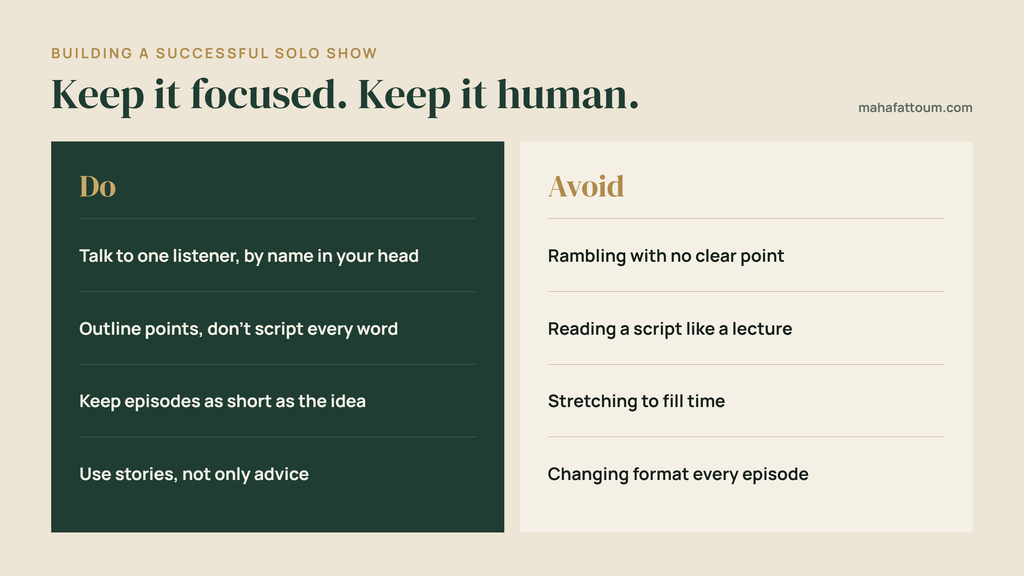
- Use an outline, not a script. Reading a full script tends to flatten your voice. A list of five points, each with a story or example, keeps you natural and on track.
- Start with the point. Skip the long warm-up. In the first half minute, say what the episode covers and why it matters.
- Vary your rhythm. Short sentences. Then a longer one that takes its time. Then a pause. A second or two of silence often sounds confident, not awkward.
- Interview yourself. After you make a claim, ask what a curious guest would ask: “Why does that matter?” “What happened next?” “Where could this be wrong?” Then answer. It gives the episode some of the push and pull a guest would normally provide.
- Edit lightly. A small hesitation or a laugh makes you sound human. Cut the long dead stretches, not every imperfection.
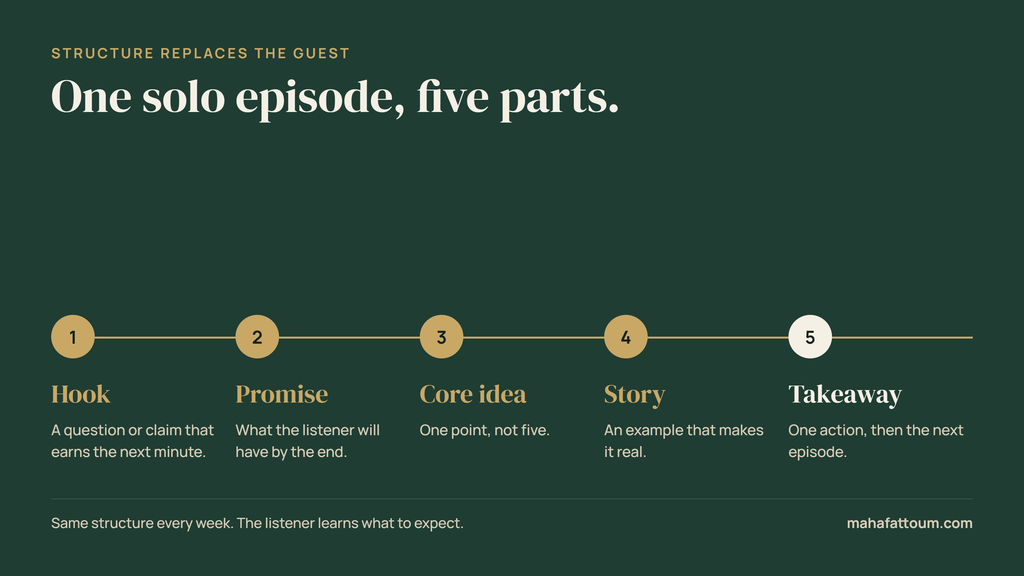
Here’s a simple structure that suits many episodes:
- Hook: the problem or question, and why it matters.
- Story: a specific moment that shows the problem.
- Idea: what you believe or learned, with your reasoning.
- Complication: where the idea breaks down or has limits.
- Takeaway: one thing the listener can do or think about.
Time each part to fit the idea. Shorter is fine if the point is made.
How to Grow a Podcast Without Guests
Here’s the part many new solo hosts don’t see coming. A guest often shares the episode with their own followers, and for interview shows that can be a major source of new listeners. When you go solo, that built-in sharing mostly disappears, so growth has to come from other places.
Get specific about your audience. A broad show competes with everything. A narrow one is easier to recommend. “A podcast for first-time managers” is easier to pass along than “a show about leadership.”
Make every episode easy to describe. Give each one a single idea that fits in a sentence. People share what they can summarize.
Reuse the best parts. A strong moment becomes a short clip. A useful explanation becomes an article or newsletter. A question your audience keeps asking becomes your next episode. The goal isn’t to repeat the same episode everywhere, but to present its core in the form each audience prefers.
Collaborate without hosting guests. You can appear on other people’s shows, swap recommendations with creators in your space, or take part in communities where your listeners already gather. You don’t need to interview anyone to be part of a network.
Bring your listeners in. Ask for questions, stories, and disagreements, and respond to a few on air. It makes a solo show feel like a conversation and gives you material for future episodes.
Stay consistent. A pace you can keep for a long time usually builds more trust than a burst of weekly episodes followed by silence. Pick a schedule that survives a busy month.
Be patient early on. Growth often starts slowly, with listeners who already know you or care about your topic. Serve that small group well.
Mistakes That Quietly Sink Solo Shows
These patterns are easy to fall into:
- No defined audience. Speaking to everyone usually means resonating with no one.
- No shape. If every episode is a fresh improvisation, listeners can’t tell what they’re signing up for.
- Too much summary, too little experience. Rounding up what others said is less interesting than sharing what you’ve done or concluded.
- Episodes longer than the idea. More minutes aren’t more value. If the point takes twelve minutes, let it take twelve.
- Reading from a script. It tends to sound stiff.
- Starting with equipment instead of the idea. Buying gear is easier than answering “why does this show exist?”
- Treating each episode as a separate piece. A show builds a presence over time, so think about what connects the episodes.
- Stopping before finding your rhythm. The first few episodes are rarely the best, so give the show time to settle.
Do You Need to Film a Solo Podcast?
Video podcasts are everywhere now, so the question comes up a lot. Start from your audience and your content, not the technology.
If your episodes rely on demonstration, your expressions, or moments that clip well for social platforms, video may help. If the show is reflective, or your listeners mostly tune in while commuting or working, audio-only may suit them better.
Filming alone can feel strange at first. If that’s a concern, you can begin with audio and add video later once you’re comfortable. Whatever you choose, don’t let filming become the goal. The idea and how you deliver it matter more than the camera.
A Quick Word on AI Tools
AI tools can handle plenty of the mechanical work around a solo show: transcribing episodes, pulling out themes, suggesting titles, cleaning up background noise, and flagging moments worth clipping.
They can’t supply your experience or your point of view, which is the reason people listen to a solo show at all. Use them to speed up production, and check anything they produce, especially facts, titles, and descriptions, before you publish.
When a Second Opinion Helps
Sometimes the problem isn’t the format or the gear. You’re just stuck. Talking to someone experienced can help if:
- The idea has been in your head for months and hasn’t moved.
- You started a show and stalled after a few episodes.
- You have plenty of experience to share but no clear way to organize it into a show.
A calm conversation without the pressure to produce anything can help you ask the questions you’ve been skipping: who the show is for, what shape it should take, and what you want it to build over time.
Frequently Asked Questions About Solo Podcast
What is a solo podcast?
A solo podcast is a show hosted by one person, with no regular guests or co-hosts. The host carries the whole episode, usually through stories, teaching, commentary, or analysis.
How to start a solo podcast with no experience?
Start with the idea, not the equipment. Decide who you’re talking to, write a one-sentence promise for the show, and outline your first ten episodes. Record a practice episode just for yourself, then choose a simple microphone and a quiet room. Skills improve with practice.
What are good solo podcast format ideas?
Common options include single-topic deep dives, story-based episodes, listener Q&A, short weekly notes, commentary on your field, case study breakdowns, and learning journals. Many hosts combine two or three, as long as listeners know what to expect.
How to grow a podcast without guests?
Focus on a specific audience, give each episode one clear idea that’s easy to share, reuse the best moments as clips and articles, appear on other people’s shows, involve your listeners through questions, and stay consistent. Growth often starts slowly, so give it time.
How long should a solo episode be?
As long as the idea needs. Many solo hosts find that somewhere between ten and thirty minutes works, but a tight twelve-minute episode usually serves listeners better than a rambling forty-minute one.
Do I need a script for a solo podcast?
Usually not a full one. A loose outline with a story or example for each point tends to sound more natural. If you freeze at the start, write out just your opening lines.
Can a solo podcast succeed without an existing audience?
It can, if it serves a specific listener and offers a clear point of view. The show itself can become how you build that audience, although it may take patience.
Is video necessary for a solo podcast?
No. It depends on your content, your audience, and where you want to be found. Video can widen the ways you reuse episodes, but a strong idea and clear delivery matter more than the format.
Start Small, Then Listen Back
A solo podcast isn’t a lesser version of an interview show. It’s a different instrument, and it rewards people who know what they think, can tell a good story, and are willing to sound a little exposed.
If you’re still drawn to it, do two things this week. Write your twenty episode titles, then record one rough episode that no one will hear but you. That single recording will teach you more about whether this format fits than another month of planning.