Almost every podcast begins with a throwaway line over coffee: “We should start a show.”
Then the list of questions shows up. What’s it about? Who’s going to listen? Who do we book as guests? Do we film it? Weekly or biweekly? Do we need a studio?
Those all matter eventually. But there’s a question that sits underneath every one of them, and most people skip right past it:
Out of everything your listener could press play on today, why would they pick your episode?
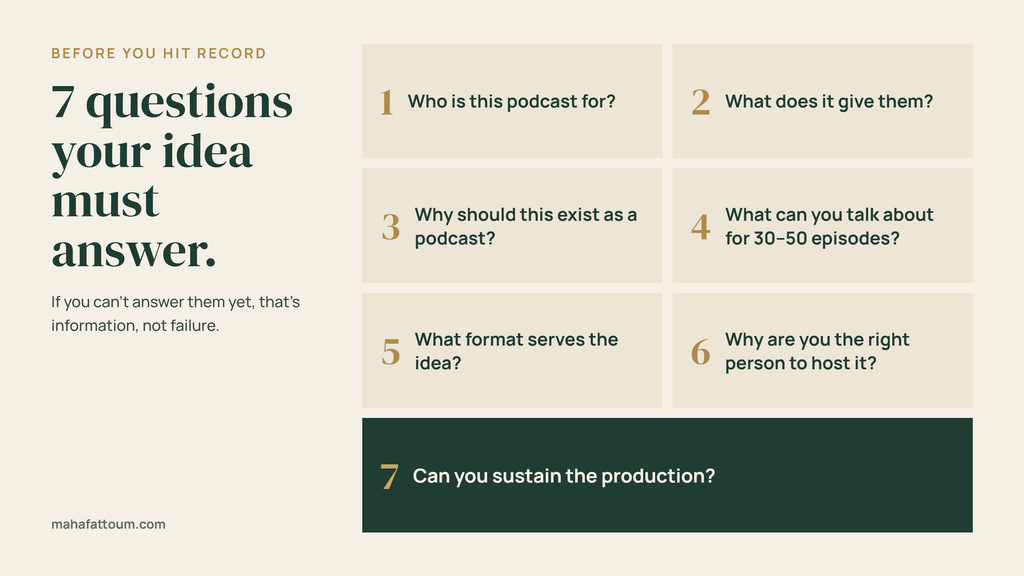
If you don’t have a clear answer yet, that’s fine. Honestly, it’s the normal starting point. The goal of this post is to help you find the answer before you’ve spent money, time, or goodwill with a guest list. Below are seven questions to work through, plus a podcast concept checklist you can screenshot and keep.
Should I Start a Podcast? Start With This Instead
“Should I start a podcast?” is the question I hear most, usually followed by a nervous laugh and “or is it too late?”
It’s not too late. But “should I” isn’t really about timing, gear, or whether your voice is smooth enough. It’s about whether you have a reason for the show to exist that goes beyond “podcasts are everywhere” or “my competitors have one.”
Think about your own listening habits. Nobody opens their podcast app thinking, “I’d love some more content today.” You listen because a friend said an episode changed how they think about money, or because you’re stuck on a problem at work and want to hear from someone who’s solved it, or because you’re simply curious about a person’s life. People are looking for help, perspective, or a good story. Rarely just volume.
So the better version of the question is: do I have something worth hearing, and can I deliver it well, more than once? If the answer is a tentative yes, keep reading. Everything else can be learned along the way.
How to Validate Podcast Idea Before You Spend a Cent
“Validation” sounds like startup jargon, but all it means here is testing your assumptions while it’s still cheap to change them.
Here’s the pattern I see over and over. Someone launches with a burst of energy. Four, five, six episodes go live. Then it gets harder. The topic feels thinner than expected. The host realizes they never decided who they were talking to. The guests, even good ones, end up answering the same questions they’ve answered on a dozen other shows. A few months later, the last episode is dated March and nobody mentions it.
The microphone had nothing to do with it. In my experience, it almost never does.
That’s why learning how to validate podcast idea concepts early pays off. It’s far easier to spot a weak point during a notebook session than after you’ve recorded, edited, and designed cover art for episode three.
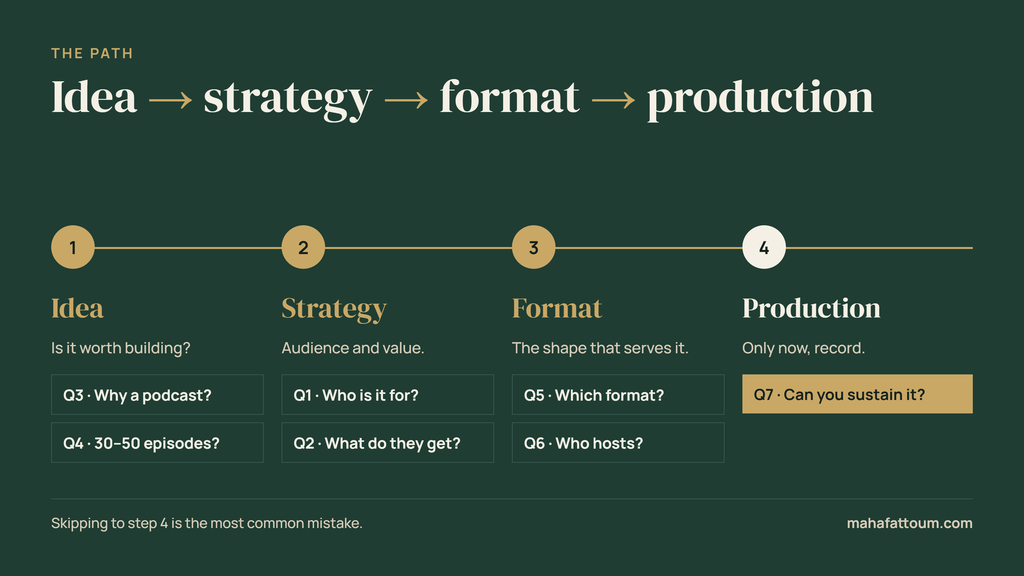
You don’t need market research software or a consultant. You need an hour of honest thinking and a willingness to hear “not yet” from yourself. Here are the seven questions.
1. Who Are You Actually Talking To?
“Anyone interested in business” is not an audience. Neither is “people who enjoy good conversations.”
Try picturing one real person instead. Maybe a first-time founder who’s about to make their first hire and is terrified of getting it wrong. Maybe a marketing manager with ten years of experience who wants to move into leadership and can’t find honest advice on how. Maybe a new parent trying to make sense of how schools have changed since they were kids.
Once you can see that person, a lot of decisions get easier. You know which topics deserve an episode, how much background to explain, and what tone won’t feel patronizing.
A quick test: complete this sentence. “After listening, my listener will feel ______ and know how to ______.” If you can’t fill in either blank, the audience is still fuzzy.
2. What Will They Get From You That They Can’t Get Elsewhere?
This is the uncomfortable one, so don’t skip it.
Search your topic in any podcast app and listen to the top five or six shows. Not to copy them, and not to get discouraged. You’re trying to hear what’s already being said and what’s conspicuously missing.
The gap can take a few forms:
- A viewpoint nobody’s offering (for example, the founder’s side and the first employee’s side of the same story)
- An audience that’s underserved, such as a specific industry, region, or career stage
- A format that feels different, like unscripted conversations instead of polished interviews
- You, with a background that changes how the topic sounds
A crowded topic isn’t a dealbreaker. Plenty of great shows live in crowded categories. A crowded topic with no angle is the problem. If the best description you’ve got is “it’s like [popular show], but with me,” keep working on it.
3. How to Choose a Podcast Topic You Won’t Get Sick Of
If you’re wondering how to choose a podcast topic, skip the trend reports. Look for the place where three things overlap:
- What your audience keeps asking about. Check comment sections, community forums, client emails, and the questions people ask you at events.
- What you’ll still find interesting in twelve months. People forget this one. Something that thrills you in week one can feel like homework by episode twelve.
- What you’ve actually lived or done. Not what you’ve read. What you’ve tried, botched, fixed, or watched up close.
Then run the twenty-title test. Sit down and write twenty possible episode titles. If they come quickly and feel different from one another, the topic has room to breathe. If you’re scraping by title nine, or everything sounds like a rewording of the same idea, the topic might be too narrow or the concept needs more shaping.
Also ask whether the topic can grow with you. A show about “social media for dentists” is a clear niche, but could it carry fifty episodes? Maybe yes. Maybe you’d want to zoom out slightly to “marketing for local healthcare practices.”
4. Do You Have Stories, Not Just Information?
Information is everywhere. Anyone can pull up a list of tips in thirty seconds. What audio does well, and what short posts can’t, is carry context.
Imagine a founder describing the week she almost shut down her company. The lesson matters, sure. But so do the details: the sleepless night, the email she drafted and deleted, the advisor who gave her the one piece of advice she didn’t want to hear. That texture is what people remember, and it’s what makes a conversation feel earned.
Be honest with yourself on these:
- Do I have firsthand experience here, or am I mostly summarizing other people’s work?
- Can I name specific moments, decisions, and consequences?
- Do I hold a point of view I’m willing to defend, politely?
This applies to businesses too. A company doesn’t need to pitch itself every episode. Talking openly about shifts in your industry, or digging into problems your customers wrestle with every week, usually builds more trust than a sales message ever will.
5. Who Would You Actually Invite?
If your show has guests, this question can make or break the plan.
The most famous name isn’t automatically the best guest. A person who’s lived through one very specific situation will often give you a better episode than a big name who’s on autopilot.
For each potential guest, run through this quick filter:
- Have they truly been through what we’ll talk about?
- Can they explain it in a way a non-expert would follow?
- Do they have a perspective listeners won’t hear everywhere else?
- Will the audience see themselves in the story?
If you can list ten people who clear that bar and you could realistically reach out to them, that’s a healthy sign. If you’ve got two or three, or your list is mostly dream guests who’ve never heard of you, your guest pipeline might be the bottleneck.
One practical tip: prepare your guests, but don’t script them. Tell them who’s listening, what kind of stories land, and what you’re hoping to dig into. Someone can be brilliant at their job and still unsure how to talk about it for an hour. A short pre-call fixes that without making anyone sound rehearsed.
6. What Is the Show Supposed to Do for You?
“Strategy” can sound heavy, so let’s shrink it. It just means knowing why you’re making this and what you want it to turn into.
Common goals include:
- Building your name in a specific field
- Creating a home for in-depth conversations on one topic
- Raising your company’s profile in its industry
- Reaching an audience you can’t reach through other channels
- Building relationships with experts and people of influence
None of these is “better.” But which one you pick affects nearly everything: the topics, the guests, the interviewing style, even what you do with each recording afterward.
That last bit matters more than people expect. One strong episode can become short clips, a blog post, a newsletter section, a LinkedIn thread, or the seed of next month’s episode. If you know the goal upfront, you can plan for that instead of scrambling later.
AI tools can speed up the mechanical work, like transcripts, summaries, title ideas, and flagging moments worth clipping. What they can’t do is live your experience or notice that a guest’s offhand comment deserves a follow-up. The faster production gets, the more the human side of the conversation stands out.
7. Can You Keep This Up Past Episode Ten?
Most podcasts don’t crash. They drift off.
Before you commit, be realistic about your capacity. How many hours can you give this each week? Who’s handling editing, publishing, and promotion? What happens when work gets busy or your best guest cancels?
A modest schedule you can sustain beats an ambitious one you can’t. Two episodes a month for two years will do more for you than weekly episodes that stop after six weeks.
Here’s a simple gut check: outline your first ten episodes. A working title, the main question, and a possible guest for each. No scripts. If the exercise energizes you, great. If it feels like a chore, take that seriously. It’s useful information.
Podcast Concept Checklist to Validate Podcast Idea
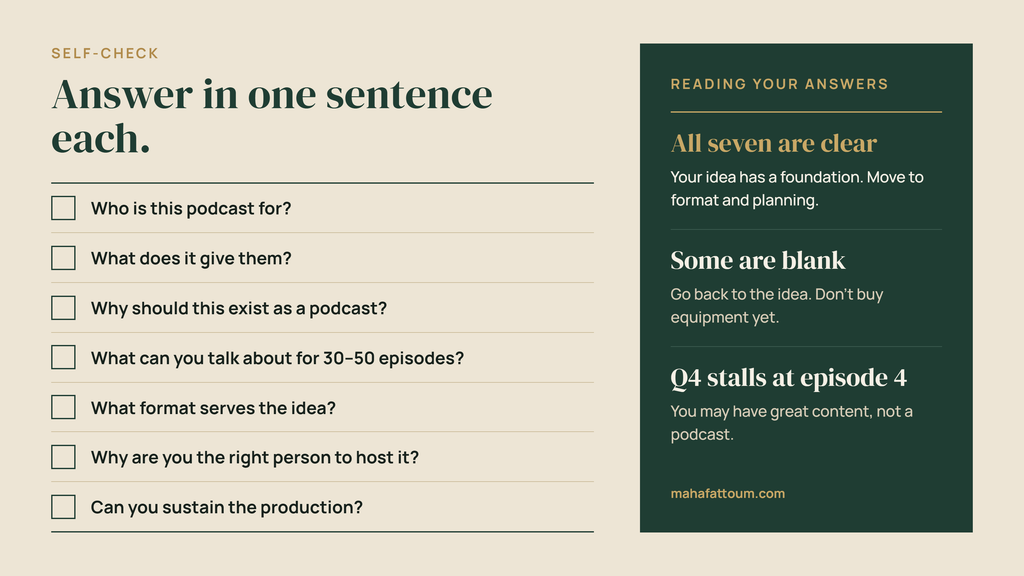
Here’s a one-page podcast concept checklist that pulls everything together. If you’re stuck on two or more rows, the idea probably needs more thinking before you invest in equipment.
| Question | A strong answer sounds like | Red flag |
|---|---|---|
| Who is it for? | You can describe one specific listener and what they need | “Anyone who’s into the topic” |
| What’s the gap? | You can say what existing shows are missing | “Like [big show], but mine” |
| Can the topic last? | Twenty distinct episode ideas, written quickly | You hit a wall around episode eight |
| Do you have stories? | Specific moments, mistakes, and decisions | Mostly rehashing other people’s takes |
| Who will you invite? | Ten or more realistic guests with real experience | A wish list of famous names you can’t reach |
| What’s the goal? | A clear reason for the show and what it builds | “Everyone has one, so why not?” |
| Can you sustain it? | A realistic schedule and ten episodes outlined | Big promises with no time or help |
A One-Week Test You Can Run Without Recording Anything
Thinking only gets you so far. A few real-world checks will tell you more than another night of brainstorming. Over the next seven days, try some of these:
- Talk to five people who fit your target listener. Ask what they listen to now, what they wish existed, and what annoys them about current shows. Mostly listen.
- Pitch the show in two sentences to a friend. If they can repeat it back in their own words, the concept is clear. If they squint, simplify.
- Write three sample episode pitches. Each gets a title, a core question, and a guest idea. Show them to someone you trust and see which one they ask about first.
- Listen to five related shows. Write down what they do well and what they skip.
- Record a rough conversation just for yourself. No editing, no publishing. Notice whether you enjoy it and whether the conversation goes somewhere interesting.
That last one is surprisingly revealing. Some ideas sound great in your head and fall flat out loud. Others turn out better than you expected.
Do You Need to Film It?
Video podcasts are everywhere now, so this question comes up constantly. Don’t start with the tech. Start with the show.
If your content leans on expressions, chemistry between speakers, or moments that look good in a clip, video can be a real advantage. If the conversation is reflective, or your audience mostly listens while commuting or working, audio-only might serve them better.
Just don’t let filming become the point. Nobody remembers which camera you used. They remember the story they heard and the idea that stuck with them afterward.
When It’s Worth Getting a Second Opinion
Sometimes the idea isn’t the problem. You’re stuck with it. A conversation with someone experienced can help if:
- The idea has been floating around your head for months without going anywhere
- You launched, then stalled after a handful of episodes
- You have great experience to share but no clear way to organize it into a show
A low-pressure chat, with no deadline to produce anything, is often enough to surface the questions you’ve been missing, define your audience and format, and think through how the show can keep a meaningful presence over time.
Frequently Asked Questions About How to Validate Podcast Idea
Should I start a podcast if I don’t have an audience yet?
Yes, as long as you have a clear subject and something real to say. A small, engaged group of listeners is worth more than a big passive one, and a podcast can actually be how you build that following. Clarity matters more than reach at the start.
How to validate podcast idea without spending money?
Talk to potential listeners, listen to what’s already out there in your niche, outline ten episodes, and record one private practice conversation. None of it costs anything, and it’ll tell you more than a new microphone will.
How to choose a podcast topic if I’m interested in too many things?
Look for the overlap between your real experience, your audience’s needs, and what you’ll still enjoy next year. If more than one topic passes, go with the one where you can name the gap most clearly, or pick a broader umbrella theme with a distinct angle.
What should a podcast concept checklist include?
At a minimum: your target listener, the gap you fill, a topic with staying power, your own stories or experience, a realistic guest list, a long-term goal, and a schedule you can keep. The table above covers all seven.
Do I need a strategy before launching?
You need direction, not a thick document. Know why the show exists, who it’s for, and what you want it to build. That alone improves almost every decision that follows.
Why do some podcasts fail?
Usually it comes down to a fuzzy idea, no defined audience, guests chosen for fame instead of experience, flat conversations, or treating each episode as a one-off instead of part of a bigger presence. Showing up consistently isn’t enough if listeners have no reason to come back.
Before You Ask “How Do I Start?”, Ask “What Am I Building?”
A podcast worth making isn’t built around a microphone. It’s built around a conversation that matters to a specific person, hosted by someone with the experience to make it honest.
Work through the seven questions and be a little ruthless with your answers. If the idea holds up, you’ll start with real confidence. If it doesn’t, you’ve saved yourself months of effort and probably figured out what to build instead.
People rarely stay loyal to a podcast as a format. What stays with them is the story they heard, the idea they kept thinking about, and the conversation that made them see something differently.